


What It Really Feels Like to Witness a River Crossing (Personal Account)
There are wildlife moments you anticipate, and then there are those you feel long before they happen. A river crossing in the northern reaches of Serengeti National Park is firmly in the second category. It is not just something you see. It is something you sense building, layer by layer, until it becomes impossible to ignore.
I had imagined the scene many times before arriving. Like most people, my expectations were shaped by documentaries—perfect angles, dramatic music, carefully edited sequences that compress hours into minutes. What I did not expect was the waiting. The uncertainty. The slow, almost unbearable tension that defines the experience long before a single animal enters the water.
We arrived early in the morning at a crossing point along the Mara River, close to the boundary with Maasai Mara National Reserve. The air was still cool, carrying the scent of damp earth and vegetation. At first glance, the river seemed calm, almost unremarkable. If you didn’t know what it represented, you might have overlooked it entirely.
But nothing about that place was ordinary.
The Weight of Anticipation
The first thing that strikes you is the silence—not the absence of sound, but the presence of something heavier underneath it. The guides speak in low tones. Engines are switched off. Even the wind seems to move more carefully.
You wait.
Minutes stretch into something longer. Time behaves differently in that environment. There is no clear timeline, no guarantee that anything will happen. And yet, everyone stays. Every vehicle positioned along the riverbank remains still, as if locked into place by a shared understanding that something significant could unfold at any moment.
Then, slowly, the atmosphere begins to change.
At first, it is just a faint vibration. You feel it before you hear it—a subtle trembling through the ground, barely noticeable but impossible to ignore once you focus on it. Then the sound follows. A distant rumble, low and continuous, like thunder that refuses to break.
The herd is coming.
The First Sight of the Herd
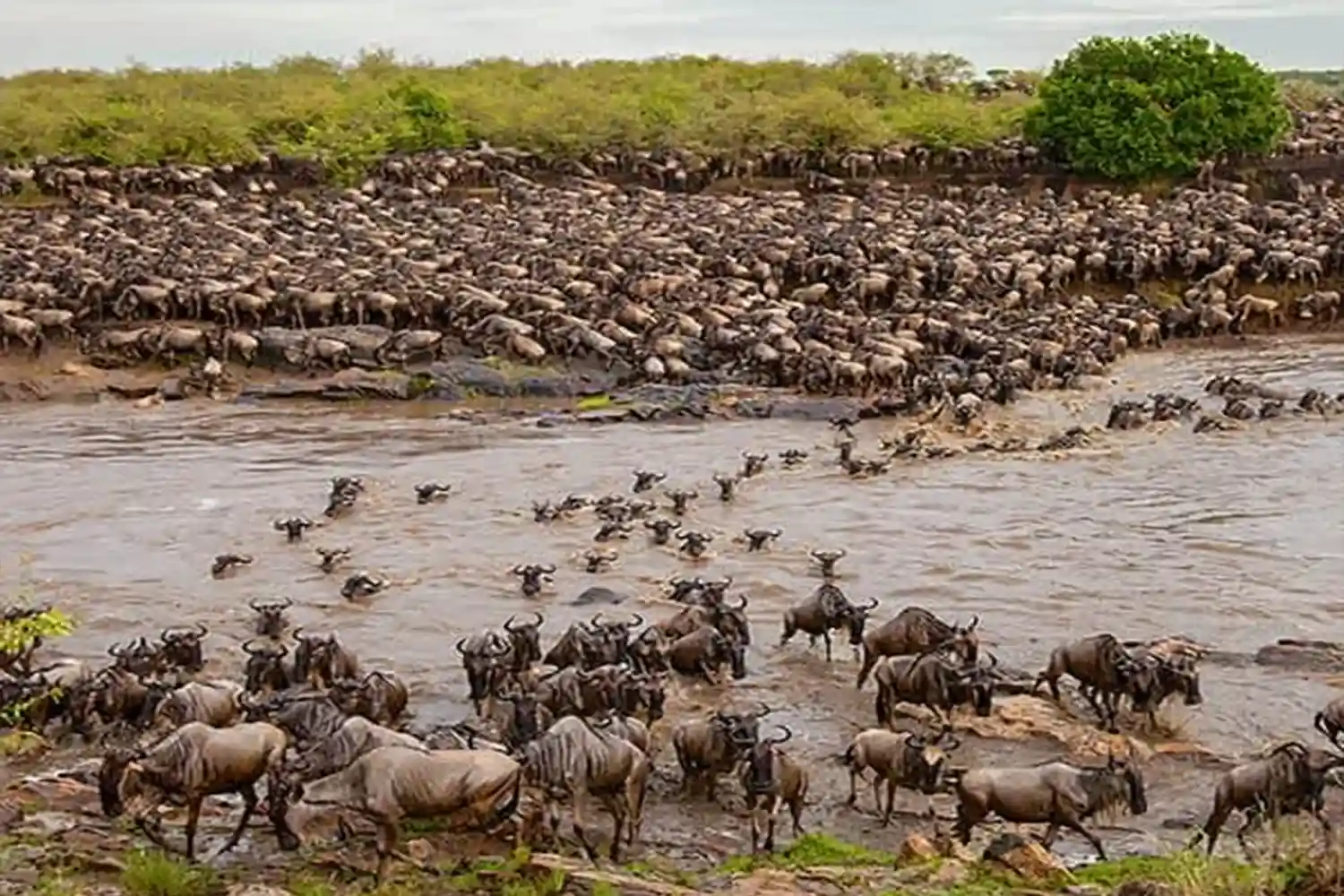
When the wildebeest finally appear, they do not arrive with the drama you might expect. There is no sudden charge, no immediate chaos. Instead, they emerge gradually, forming a line that thickens into a mass.
Hundreds become thousands.
They gather along the riverbank, pressing forward, then pulling back. The movement is restless, uncertain. The front line edges closer to the water, while those behind continue to push, creating a constant pressure that never quite resolves into action.
This is where reality diverges sharply from expectation.
In films, crossings often appear decisive, almost inevitable. In truth, hesitation dominates. The animals know the risk. You can see it in their behavior—the way they test the edge, retreat, and regroup. Some step forward only to turn away at the last second. Others stand frozen, staring at the water as if trying to calculate something beyond instinct.
The river holds its own presence.
It is not loud or aggressive. It does not need to be. Its stillness is enough. Beneath the surface, there is movement, but it is subtle, almost invisible. Occasionally, a shape shifts—a crocodile adjusting position, a ripple that moves against the current. These small signs carry enormous weight.
The herd senses them.
The Moment Everything Changes
There is no clear trigger for what happens next.
One wildebeest steps forward. It lingers at the edge for a fraction of a second longer than the others. Then it jumps.
That single action breaks the tension like a snapped wire.
Within seconds, the entire dynamic shifts. The hesitation dissolves into movement. The animals behind surge forward, compressing the front line and forcing more bodies toward the edge. What was moments ago a slow, uncertain gathering becomes an unstoppable wave.
The sound explodes.
Hooves strike the ground in rapid succession, sending dust into the air. Animals collide, stumble, regain footing, and continue forward. The steep riverbank offers little stability. Some slide down uncontrollably, while others leap, landing heavily in the water below.
The noise is overwhelming. It fills every space, leaving no room for thought.
Inside the Crossing
Once the animals enter the river, the chaos intensifies.
The Mara River is not a gentle crossing. The current pulls at the animals, forcing them to swim at an angle rather than in a straight line. Their bodies twist as they fight to maintain direction. Heads rise and fall above the surface, nostrils flaring, eyes wide with effort.
There is no order. No formation. Just movement.
And then the river reveals its other inhabitants.
Crocodiles are not immediately visible. They blend into the water, their presence suggested more by absence than by form. Then, without warning, one strikes.
The water erupts.
A sudden surge, a violent snap, and for a brief instant, you see the raw mechanics of predation. There is no prolonged struggle, no dramatic pause. The moment is swift, decisive, and then it is gone.
The crossing continues.
This is perhaps the most difficult part to process. The herd does not stop. It cannot. The momentum is too great, the instinct too strong. Survival is not about avoiding danger entirely but moving through it as quickly as possible.
The Physical Experience of Watching
What no photograph or video can fully convey is how physical the experience feels.
You do not simply observe a river crossing. You absorb it.
The ground vibrates under the collective force of thousands of hooves. The air fills with dust, carried upward in thick clouds that catch the light and obscure the edges of the scene. The smell intensifies—a mixture of mud, water, and animals packed tightly together.
The heat builds as the morning progresses.
Your senses are overwhelmed. There is too much to take in at once, and yet you cannot look away. Every direction offers something different—a new group entering the water, a struggle along the bank, a sudden shift in movement that draws your attention.
It is not a controlled environment. It is not curated.
The Struggle to Exit
Reaching the far side of the river does not mean the crossing is over.
In many ways, the most difficult part begins there.
The banks are steep and unstable, often made of loose soil or slick mud. Animals attempt to climb out, their hooves slipping as they search for traction. Some succeed immediately, scrambling to the top and disappearing over the edge. Others fail, sliding back into the water and trying again.
The pressure from behind continues.
More animals are still entering the river, pushing those in front toward the bank. The result is a bottleneck of effort and exhaustion. You can see the strain in their movements—the slowing pace, the repeated attempts, the moments where an animal seems to pause, gathering just enough strength to try again.
Eventually, the momentum shifts.
A few find a stable path. Others follow. The flow begins to move upward rather than forward. One by one, then in groups, the animals climb out and continue across the plains.
The Sudden End
And then, just as abruptly as it began, the crossing ends.
The last of the herd clears the river. The noise fades. The dust begins to settle. The water, once churned into chaos, gradually returns to its previous state—calm, almost indifferent.
Crocodiles drift back into stillness.
The riverbank, moments ago alive with movement, becomes quiet again. The vehicles remain in place, but something has shifted. The collective tension releases, replaced by a kind of reflective silence.
No one speaks immediately.
Processing the Experience
There is a moment after the crossing where your mind struggles to catch up with what you have just witnessed.
It is not just the scale, though that alone is extraordinary. It is the intensity, the immediacy, the lack of distance between observer and event. There is no barrier, no filter. You are present in a way that feels almost intrusive, as if you have stepped into something that was never meant to include you.
The emotional response is complex.
There is awe, certainly. The sheer number of animals, the coordination within chaos, the persistence of movement—it is all deeply impressive. But there is also a sense of discomfort, an awareness of the risks involved and the outcomes that are not always visible in curated narratives.
This is not a performance.
It is not designed for an audience.
It is life unfolding according to its own rules.
A Different Understanding of Nature
Witnessing a river crossing changes your perspective on wildlife.
It removes the abstraction. Animals are no longer distant subjects in a landscape. They become participants in a continuous, demanding process of survival. The migration is not a single event but a cycle, one that repeats year after year with variations that cannot be predicted or controlled.
Standing there, you begin to understand the scale of that cycle.
The Serengeti-Mara ecosystem is not defined by isolated moments but by movement—constant, necessary, and often unforgiving. The river crossing is simply one point within that larger system, but it is a point where everything becomes visible at once.
Describing a river crossing as a “spectacle” is accurate, but it does not capture the full experience. The word suggests something staged, something designed to impress. What you witness along the Mara River is far more complex.
It is intense, unpredictable, and deeply real.
For a first-time observer, it can be overwhelming. For those who return, it never becomes routine. Each crossing is different, shaped by conditions, timing, and the behavior of the herd. No two moments are identical.
Long after you leave the riverbank, the memory remains vivid. Not as a sequence of images, but as a collection of sensations—the sound of hooves, the movement of water, the weight of anticipation, and the sudden release of action.
It stays with you because it is not easily simplified.
It resists neat conclusions.
And that is precisely what makes it unforgettable.