


Tarangire National Park: Why Elephants and Baobabs Steal the Show
Tarangire National Park sits slightly off the main northern Tanzania circuit, often overshadowed by the fame of Serengeti National Park and the density of the Ngorongoro Conservation Area. Yet for travelers who understand ecosystem dynamics rather than just headline destinations, Tarangire delivers one of the most visually distinctive and behavior-rich safari environments in East Africa.
Its identity is defined by two dominant forces: elephants and baobabs. These are not just visual highlights—they are structural components of the park’s ecology. Together, they shape movement patterns, feeding behavior, and even the visual language of the landscape itself.
Understanding why these two elements dominate Tarangire requires looking beyond surface sightings and into how the park functions seasonally and ecologically.
The Tarangire Ecosystem: A Dry Season Magnet
The Tarangire River as a Lifeline
At the core of the park lies the Tarangire River, a permanent water source that becomes critically important during the dry season.
As surrounding areas dry out, wildlife from outside the park migrates inward toward this river system. This creates a seasonal concentration effect that dramatically increases wildlife density.
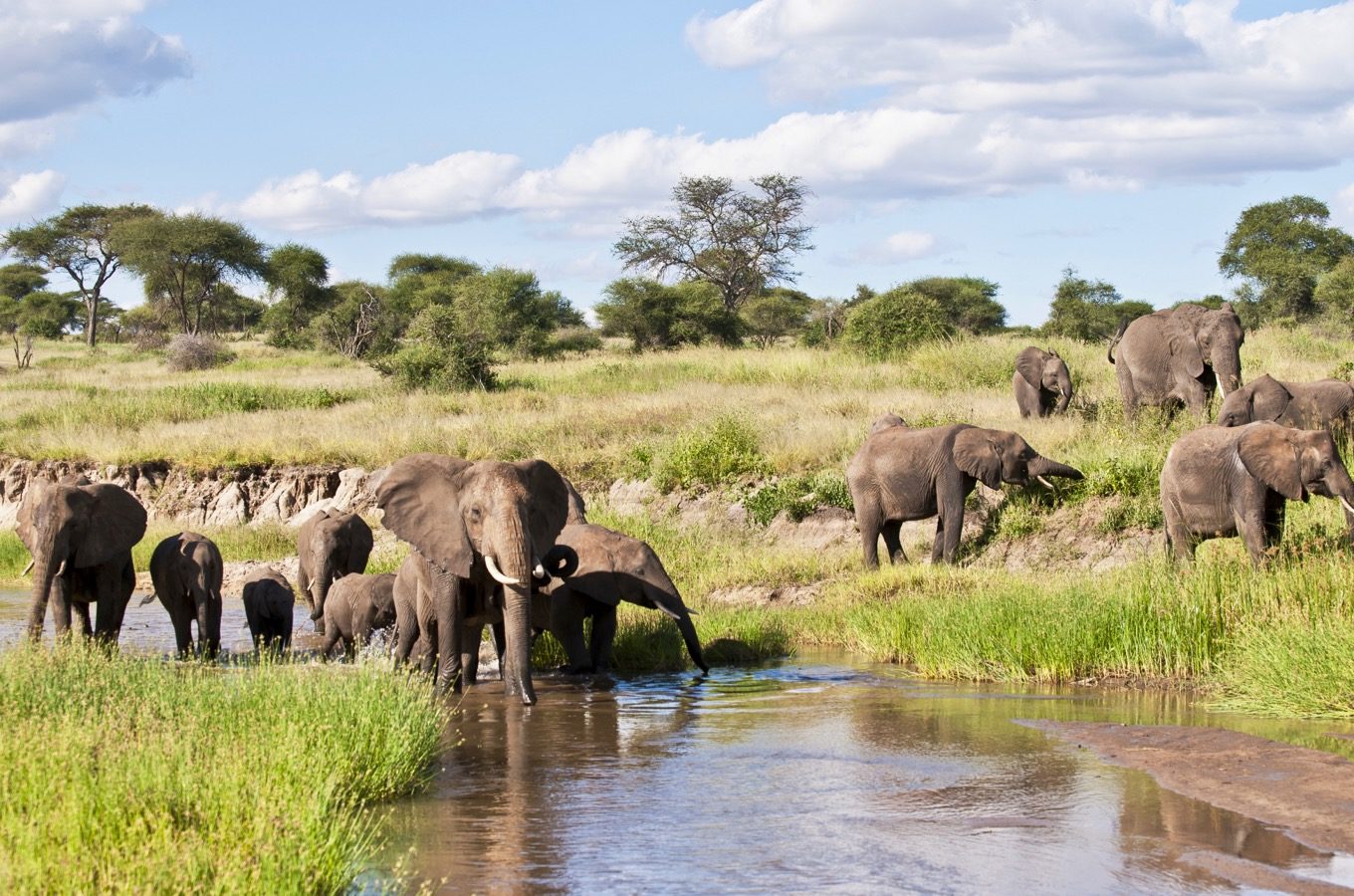
Elephants, in particular, respond strongly to this water availability, gathering in large numbers along the riverbanks.
Seasonal Transformation of the Landscape
During the wet season, Tarangire disperses. Animals spread out into surrounding ecosystems where water and grazing are widely available.
During the dry season, the park contracts into a high-density wildlife zone centered around the river.
This seasonal compression is what makes Tarangire one of the best places in Tanzania to observe elephant behavior at scale.
Elephants: The Dominant Force in Tarangire
Large Herd Structures
Tarangire supports some of the largest elephant populations in northern Tanzania.
Herds can number in the dozens or even hundreds during peak dry season conditions. These are not random groupings but structured social units composed of related females and their offspring, led by experienced matriarchs.
Multiple herds often converge along river systems, creating layered social interactions that are difficult to observe in lower-density environments.
Behavioral Visibility
What makes Tarangire particularly valuable is not just the number of elephants, but how observable their behavior becomes.
Because they gather in predictable areas, it is possible to observe:
Feeding strategies across different vegetation types
Social bonding and communication
Protective behavior toward calves
Water interaction and bathing patterns
These behaviors are easier to interpret in Tarangire than in more dispersed ecosystems.
Elephant Movement Patterns
Elephants in Tarangire follow seasonal migration routes, moving in and out of the park depending on water availability.
Understanding this movement explains why the park feels quiet during some months and highly active during others.
Baobabs: The Architectural Backbone of the Landscape
The Iconic Form of Baobab Trees
Baobabs are among the most visually striking trees in Africa, with massive trunks, sparse branches, and a silhouette that dominates the horizon.
In Tarangire, they are not isolated features—they are a defining landscape element.
Their presence creates a sense of scale and permanence that contrasts sharply with the movement of wildlife.
Ecological Role of Baobabs
Baobabs are more than visual icons. They function as ecological anchors within the park.
Their trunks store water, their bark can be used by animals, and their fruit provides nutritional value for various species.
Elephants are known to strip bark from baobabs, a behavior that can shape tree structure over time.
Interaction Between Elephants and Baobabs
The relationship between elephants and baobabs is one of the most distinctive ecological interactions in Tarangire.
Elephants feed on baobab bark, sometimes hollowing out sections of the tree. While this can damage individual trees, baobabs are highly resilient and often survive repeated interaction.
This ongoing interaction creates a visible record of ecological pressure and adaptation.
Wildlife Beyond Elephants
Predator Presence
While elephants dominate attention, Tarangire also supports predators such as lions, leopards, and cheetahs.
These species follow prey movement patterns, which are influenced by water availability and vegetation density.
Predator sightings are less predictable than in the Serengeti but still significant, particularly during the dry season.
Herbivores and Grazing Species
Zebra, wildebeest, impala, and giraffe are commonly seen within the park.
These species contribute to the overall ecosystem structure and support predator populations.
Their distribution often mirrors that of water sources and grazing conditions.
Birdlife Diversity
Tarangire is also a strong birding destination, with a wide range of species supported by riverine habitats and woodland areas.
Birdlife adds another layer of ecological richness beyond large mammals.
Why Tarangire Feels Different From Other Parks
Lower Vehicle Density
Compared to the Serengeti and Ngorongoro, Tarangire generally experiences fewer vehicles.
This creates a more relaxed and less congested safari experience, particularly during peak wildlife periods.
Landscape Character
The combination of baobabs, river systems, and open woodland creates a distinct visual identity.
Unlike the endless plains of the Serengeti, Tarangire feels structured and varied.
Focus on Behavior Over Spectacle
Tarangire is less about dramatic migration scenes and more about sustained observation.
It is a park where time spent watching elephant herds can be more rewarding than chasing multiple species sightings.
Best Time to Visit Tarangire
Dry Season Advantage
The dry season is the optimal time to visit Tarangire.
Wildlife concentrates around the Tarangire River, and vegetation thins out, improving visibility.
Elephant numbers peak during this period, making it the best time for large herd encounters.
Wet Season Considerations
During the wet season, wildlife disperses and the park becomes greener.
While this reduces large herd sightings, it enhances scenery and birdlife activity.
How Tarangire Fits Into a Northern Tanzania Safari
Tarangire is often included at the beginning or end of a northern circuit itinerary.
It pairs well with:
Serengeti National Park for large-scale migration
Ngorongoro Conservation Area for high-density crater wildlife
This combination allows travelers to experience different ecological systems within a single trip.
Tarangire’s Appeal
In practical safari terms, Tarangire is not about variety—it is about dominance.
Elephants dominate movement, presence, and behavior. Baobabs dominate structure and visual identity.
Together, they create a park that feels cohesive rather than fragmented.
For travelers who value depth over breadth, Tarangire offers one of the most consistent and behavior-rich wildlife environments in Tanzania.
It is a place where staying longer often delivers more value than moving quickly, and where the interaction between species and landscape becomes the central experience rather than a secondary detail.