


Rwanda Gorilla Trekking: The Complete 2026 Guide
Gorilla trekking in Rwanda is one of those travel experiences that sounds straightforward when you first hear about it, then becomes more complex the moment you start planning it. You imagine a forest walk, a wildlife encounter, and a guided experience. In reality, it is a tightly managed conservation system built around one of the rarest animals on Earth.
In 2026, Rwanda remains one of the most reliable places to see mountain gorillas in the wild. The experience is centered in a single protected area, and everything from permits to trekking groups is carefully controlled. That structure is part of what makes it work, but it also changes how the experience feels compared to other safari activities.
This guide breaks down what happens before, during, and after the trek, what it actually feels like on the ground, and what you should know before you go.
Where the experience takes place
Gorilla trekking in Rwanda happens inside Volcanoes National Park in the northwest of the country, close to the borders with Uganda and the Democratic Republic of Congo. The park sits within the Virunga mountain range, a chain of volcanic mountains covered in dense forest.
The terrain is one of the defining features of the experience. It is not flat forest walking. It is a mix of steep slopes, thick vegetation, volcanic soil, and fast-changing weather. Even short distances can feel physically demanding because of elevation gain and uneven ground.
The forest itself feels layered. You move from farmland edges into thick jungle, then into higher altitude vegetation where visibility narrows and the environment becomes more enclosed. Everything feels vertical rather than open.
This setting is not just scenery. It directly shapes how the trek unfolds.
The early morning start
The day begins early at the park headquarters. You arrive before sunrise or shortly after, depending on your accommodation. The atmosphere is structured and organized rather than chaotic. Visitors gather in an open area where park staff handle registration and briefings.
You are then assigned to a gorilla family group. This assignment is not random in the sense of luck, but it is not fully predictable either. It depends on group size, fitness level, and the location of the gorillas that morning.
Each group of trekkers is kept small. This is intentional. It reduces pressure on the gorillas and limits human impact in the forest.
After the briefing, you are driven closer to the starting point. This short transfer already begins to shift the mood. You leave behind roads and settlements and move closer to the forest edge.
From here, the walking begins.
The walk into the forest
The first part of the trek often passes through farmland and edges of forest. You see signs of human life at the margins, then gradually move into thicker vegetation.
As you enter Volcanoes National Park more deeply, the environment changes. The air becomes cooler. The ground becomes softer and more uneven. Vegetation grows thicker and more layered.
There is a point where conversation naturally reduces. People focus more on footing, breathing, and following the guide. The terrain starts to demand attention.
The walk is not a fixed route. It changes depending on where trackers located the gorilla family the previous day. Gorillas move freely, so there is always uncertainty about distance and direction.
Some treks are short. Others take several hours.
That uncertainty becomes part of the mental preparation.
How tracking actually works
What makes gorilla trekking different from many wildlife experiences is the coordination happening behind the scenes. Before you even start walking, trackers have already gone into the forest early in the morning to locate the gorilla groups.
They follow signs, movement patterns, and known sleeping areas. When they find a group, they communicate with the ranger teams leading the tourists.
This means your trek is not random exploration. It is a guided approach toward a known location, even if the exact path is not defined.
As you get closer, the forest feels different. Guides begin to slow the group. Communication becomes quieter. Footsteps become more deliberate.
There is a sense that something is near, even before you see anything.
The moment you find the gorillas
There is a clear shift when you finally reach the gorilla family.
A ranger signals for silence. The group stops. The forest feels suddenly more still, even though it is still full of natural sound.
Then you step forward.
The first sight is usually simple but powerful.
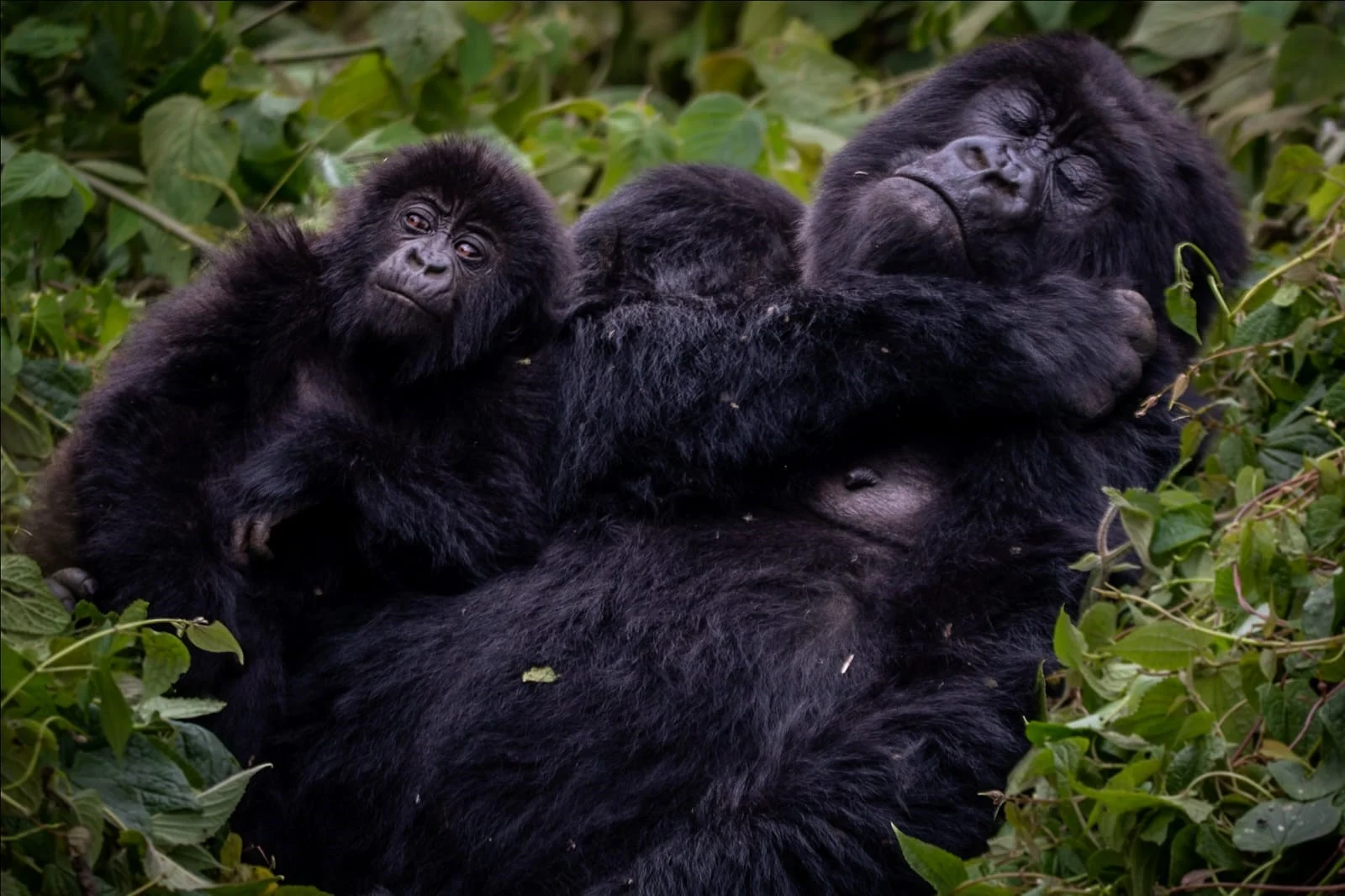
A silverback is sitting among vegetation, completely relaxed. His size is immediately noticeable, but what stands out more is his stillness. He does not react to your presence in a dramatic way. He simply observes.
Nearby, other members of the family continue their routine. A mother feeds while keeping her infant close. Young gorillas move around briefly, then settle again. There is interaction, but no chaos.
Everything feels calm and structured within the group itself.
You are not watching performance. You are watching daily life.
The one-hour experience window
Once you reach the gorilla family, you are allowed to stay for a maximum of one hour. This rule is strictly enforced in Volcanoes National Park.
The purpose is conservation. Limiting human contact reduces stress on the gorillas and helps prevent disease transmission.
That hour feels very different from other wildlife viewing experiences. There is no rush to move between sightings. You stay in one place and observe deeply.
Time feels compressed. Many visitors are surprised by how quickly the hour passes.
You shift from scanning the group to focusing on small details. The way a young gorilla interacts with its mother. The slow movements of feeding. The quiet presence of the silverback watching everything.
The experience becomes less about action and more about observation.
Physical difficulty and terrain reality
Gorilla trekking in Rwanda is physically unpredictable. Some groups are located relatively close to the starting point. Others require long hikes through steep and uneven terrain.
You may climb volcanic slopes, walk through dense vegetation, and move across slippery ground depending on weather conditions.
This is not a technical climb, but it does require stamina. The pace is steady rather than fast, but the duration is unknown.
Many travelers choose to hire porters. This helps carry bags and provides support on difficult sections of the trail. It also supports local communities directly.
Fitness level matters, but experience matters more. Moving carefully and pacing yourself makes a big difference.
Weather and seasonal conditions
Gorilla trekking is possible throughout the year, but conditions change with rainfall patterns.
During drier months, trails are more stable and easier to walk. Visibility is often better, and trekking conditions feel more predictable.
During wetter months, the forest becomes greener and more atmospheric, but trails can become muddy and slippery. This increases physical difficulty but also changes the visual experience of the forest.
The gorillas themselves do not change location based on tourism seasons. Sightings remain consistent year-round because tracking is active every day.
Permit structure and cost in 2026
Rwanda maintains a high permit cost for gorilla trekking. The price reflects conservation funding, limited visitor numbers, and park management costs.
The permit includes park entry, ranger guidance, and one hour with a gorilla family. It does not include transport, accommodation, or additional services such as porters.
While the cost is significant, it directly supports conservation programs for mountain gorillas in Volcanoes National Park.
This funding has played a major role in stabilizing gorilla populations over the years.
How Rwanda compares to other destinations
Rwanda offers a structured and highly organized trekking system. Everything is centralized around one national park, which simplifies logistics.
In comparison, Uganda offers trekking across multiple forest systems, which creates more variation in landscape and travel routes.
Rwanda’s terrain is often steeper but can involve shorter trekking distances depending on gorilla movement. Uganda often involves longer travel between forest sectors.
Both experiences are strong, but they feel different in structure and flow.
What stays with people after the trek
Most travelers do not remember every step of the hike. What they remember is the moment they reach the gorillas.
A silverback sitting quietly and watching. A mother holding her infant. Young gorillas moving through the undergrowth.
There is a shift in atmosphere that is hard to describe fully. It is not excitement in the usual sense. It is presence.
People become quieter without thinking about it. They focus more on observation than reaction.
Even after leaving the forest, that hour stays clear in memory.
Gorilla trekking in Rwanda is not a casual wildlife activity. It is a controlled conservation experience built around one of the rarest primates on Earth.
Inside Volcanoes National Park, every part of the experience is structured to balance tourism and protection. From the briefing in the morning to the limited viewing time in the forest, everything is designed with purpose.
What most travelers take home is not just the sight of gorillas, but the feeling of having been close to something rare, calm, and deeply connected as a family unit.
It is a simple experience in structure, but a complex one in memory.