


Is the Terrain Harder in Uganda or Rwanda for Gorilla Trekking?
So you’re trying to pick between Uganda and Rwanda for gorilla trekking, and the main thing on your mind is: which one’s going to kick my butt more?
Totally fair question.
Here’s the honest answer. Most people find Uganda tougher. But—and this is a big but—that doesn’t mean Rwanda is a walk in the park. And it doesn’t mean every single trek in Uganda will leave you crying for mercy. A lot depends on which gorilla family you get, what the weather does on the day, and how your own legs are feeling.
Let me break it down the way I wish someone had told me.
First, what are you actually hiking through?
Both countries are in the same mountain region—the Virungas. So yeah, there are hills, forests, and gorillas.
But here’s where it splits:
-
Uganda does its treks in Bwindi Impenetrable Forest (the name is not messing around) and Mgahinga.
-
Rwanda does theirs in Volcanoes National Park.
All of them are mountainous. But the actual feel of the hike? Very different.
Why does Uganda usually feel harder?
Okay, Bwindi. “Impenetrable” sounds dramatic, but honestly? It fits.
First, the hills are relentless. You’ll go down into a valley—feeling good, feeling strong—and then you have to climb back out. That uphill return? That’s where dreams go to die a little. Even short treks can wreck you because you’re just constantly going up and down.
Second, the forest is thick. Like, vines in your face, roots trying to trip you, bushes everywhere thick. Guides sometimes have to whack a path open with machetes. You’re not strolling on a nice trail. You’re kind of wrestling the jungle the whole time.
And third, you might be out there for a while. Some gorilla families are chill and stay close to the start. Others decide to wander deep into the forest that day. You could find them in an hour, or you could be hiking for four or five. There’s no way to know in advance—they’re wild animals, not employees.
Why Rwanda is usually a bit gentler
Rwanda’s Volcanoes National Park is just… more open.
You’re hiking up the slopes of old volcanoes. Still steep, don’t get me wrong. But the forest isn’t as dense. The trails are clearer. You’re not constantly pushing through thick stuff—you can actually find a rhythm and just walk.
Also, it’s super convenient. The park is only a couple of hours from Kigali, so you’re not already tired from a long drive before you even start.
And sometimes—not always, but sometimes—the treks are shorter. Some gorilla families live pretty close to the park boundary. But again, no promises. They can still wander off and make you work for it.
Don’t forget the altitude thing
Both places are high. Like, 2,200 to 3,000 meters above sea level.
At that height, you just… run out of gas faster. You breathe harder. Your legs feel heavier. Even an easy slope feels like more work than it should.
Rwanda’s steep volcano climbs at high altitude can surprise you. Uganda combines altitude with rough ground and thick jungle. Different kinds of suffering, but both are real.
One big thing that changes everything: rain
You know how a little mud can turn an easy trail into a nightmare? Yeah.
If it rains—and it might—those trails turn into slippery, sloppy, exhausting messes. Every step takes more effort. Going downhill becomes a careful, butt-clenching shuffle. Honestly, the weather on your trek day can matter more than which country you’re in.
Not all of Uganda is the same
Bwindi has different sectors, and they feel totally different:
To make something more detailed and paragraph-based, you basically take a short answer and stretch it out into full, flowing thoughts. Instead of just saying “solar energy is clean,” you’d explain how solar panels turn sunlight into electricity without burning anything, so no smoke or CO₂ comes out. You could also mention that, yes, making panels takes energy, but that’s getting better over time.
Then you’d move to another point, like cost. Right now, solar is often cheaper than coal or gas, so it’s not just good for the planet—it saves money too. Breaking ideas into separate paragraphs keeps things clear and easy to follow.
So in short, being more detailed means writing in full paragraphs, each focused on one idea, with a bit of flow from one to the next. If you have a specific sentence you’d like me to humanise and expand like this, just send it over.
.
Also, Uganda has Mgahinga Park, which is actually part of the same volcano range as Rwanda. So there, the difficulty is pretty similar to Rwanda. It’s really Bwindi that cranks things up.
What about older travelers?
I’ve seen people in their 60s and 70s do this just fine. Really. But if you’re worried about mobility or just want the easiest possible route, Rwanda is usually the recommendation. Shorter treks are possible, clearer trails, and less fighting through bushes.
That said, both countries have porters. You can hire someone for like $15-20 to carry your daypack and literally pull you up the steep bits. Honestly, even fit people do it. It’s cheap, it helps a local, and it makes the whole thing so much more enjoyable.
And if you’re actually fit and want a challenge?
Then Uganda might be your favorite. Bwindi feels like a real adventure. You’re deep in a wild jungle, climbing up and down, earning that gorilla sighting. A lot of serious hikers actually prefer it because it feels less like a tourist activity and more like an expedition.
So, is one better than the other?
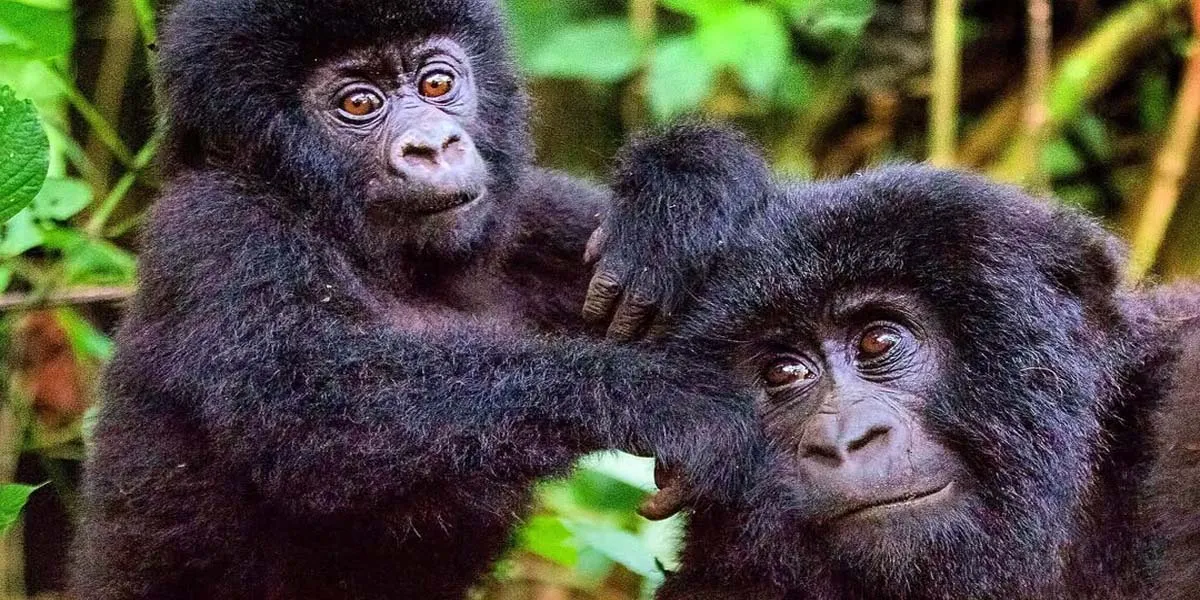
Here’s the thing. Once you’re sitting there, just a few meters from a massive silverback, watching him casually eat a leaf while his babies roll around… You completely forgot about the hike. The gorilla hour itself is the same magic in both countries.
The only real question is: what kind of journey do you want to have to get there?
A tougher trek through wilder, denser forest? That’s Uganda.
An easier, more organized trek with generally shorter hikes and less mud? That’s Rwanda.
If you just want the truth: yes, Uganda is usually harder than Rwanda. Bwindi’s valleys, dense jungle, and longer treks make it more demanding.
But Rwanda can still kick your butt if you get a steep family on a rainy day at high altitude.
Either way, thousands of people of all ages and fitness levels do this every year and have the time of their lives. Wear good boots. Hire a porter if you’re unsure. And just go—you won’t regret it.