


Is Nkuringo Sector the Hardest Trek in Bwindi?
Is Nkuringo the Hardest Gorilla Trek in Bwindi?
When I booked my gorilla trek, I was cocky. I’d hiked before. I had good boots. I thought “impenetrable” was just a dramatic marketing word the Ugandan tourism board came up with to sound cool.I was so, so wrong.
And the sector that humbled me? Nkuringo.
If you’ve been Googling around, you’ve probably seen people call this place the hardest trek in Bwindi. And I’m here to tell you—with my still-aching quads as evidence—that yeah, they’re not lying.
But here’s the twist: it nearly broke me, and I’d do it again tomorrow.
Let Me Set the Scene
You know that feeling when you wake up at 5:00 AM, it’s cold, you’re groggy, and you’re quietly questioning every life choice that led you to this damp corner of Uganda?
Nkuringo sits in the southern part of Bwindi, right up against the Rwandan border. The drive there alone is a rollercoaster—winding roads, vertigo-inducing drops, and views so stunning you forget to be scared. When you finally arrive, you’re standing on a ridge so high it feels like you’re perched on the roof of the world.
The locals will tell you “Nkuringo” means something like “round hill.”
Except there’s nothing cute about the hills. There are hundreds of them. And you’re about to climb every single one.
The Moment Reality Hit
We gathered at the trailhead. Our guide—a weathered, warm-eyed man named Emmanuel who looked like he could jog these trails in flip-flops—gave us the briefing.
“Today we go down first,” he said, smiling. “Then we come up.”
I remember thinking, Down first? That’s great! Easy start!
Oh, you sweet, summer child.
The descent was a knee-crushing, toe-jamming slip-and-slide through thick mud and tangled roots. I was gripping vines like Tarzan, trying not to faceplant while pretending I was having fun.
And then we found them.
That One Hour That Changes Everything
I’m not going to lie to you—when I finally stumbled into the clearing, I was dripping with sweat, breathing as if I’d just run a marathon, and my hands were covered in mud.
But then I looked up.
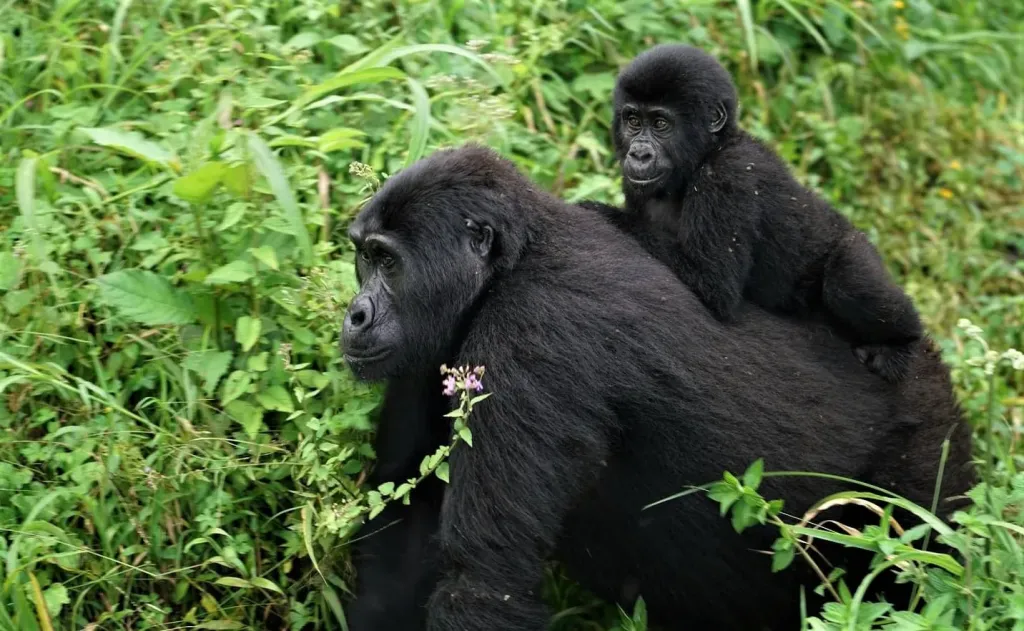
And there he was. A silverback the size of a small car, just sitting there, munching on bamboo like I didn’t even exist. He glanced at me—just a flicker of his eyes—and went right back to eating.
I forgot about my legs. I forgot about the mud. I forgot about everything.
For sixty minutes, I watched babies tumble over each other like hyperactive toddlers. I watched a mother groom her infant with such tenderness that it made my chest ache. I watched the silverback yawn, exposing teeth that could probably bite through steel, and I felt nothing but awe.
That hour moves at warp speed. It’s over before you know it. And then…
The Walk Back That Broke Me
Coming down was hard.
Going back up was psychological warfare.
Picture this: you’ve just had the most emotional experience of your life. You’re on a high. You’re floating. And then you look up at that hill—the same one you gleefully slid down hours ago, and you realize you have to climb it. In the mud. With your legs already screaming.
About halfway up, I stopped pretending to be tough.
I leaned on a tree, gasping, and looked at Emmanuel. “I don’t think I can do this,” I wheezed.
He just laughed—kindly, not cruelly and said, “You can. But let me help you.”
Why Moses Saved My Life
Moses was my porter. He was a quiet guy in his late twenties with a warm smile and arms that looked like they could carry a buffalo.
I almost didn’t hire a porter. I thought it was unnecessary. Maybe even a little embarrassing.
Thank goodness I changed my mind.
Moses took my daypack. He grabbed my camera. He put a hand on my back and literally pushed me up the steepest sections. When I slipped, he caught me. When I wanted to cry, he told me a joke.
These porters—many of them former poachers who now protect the gorillas—are the real heroes of this story. For about $15, they carry your load and your spirits. And they do it with a dignity and patience that will make you feel both humbled and deeply grateful.
I wouldn’t have made it without Moses. I mean that.
The Truth About Altitude and Mud
Here’s something nobody warned me about: the altitude.
Nkuringo sits at over 2,000 meters. That’s high enough that the air starts feeling thin. You’ll be climbing a hill, and suddenly your lungs are burning, and you’re not sure why. It’s not just you—it’s the elevation playing tricks on you.
And the mud?
Oh, the mud.
If you go during the rainy season (March–May or October–November), the trails become slip-and-slide obstacle courses. You’ll be ankle-deep in sludge, grabbing onto roots and vines, laughing nervously because it’s either that or crying.
But even in the dry season, the forest floor is damp. It’s a rainforest. Water is kind of its whole thing.
But Here’s What Nobody Tells You
Not every trek in Nkuringo is a death march.
The gorillas move. They’re wild. Some days they’re close to the trailhead. I met a couple who said their trek took barely an hour. Others spend six or seven hours in the forest.
It’s a gamble. And that unpredictability? It’s actually kind of beautiful. It means no two treks are the same. It means you’re not walking into a zoo—you’re walking into a home, and the residents do what they want.
Does Age Matter?
I saw a 70-year-old British woman complete this trek. She was slower than the rest of us, sure. She stopped more often. But she finished. And when she got to the top, she had this grin on her face that could’ve lit up the whole forest.
Meanwhile, a 25-year-old gym rat in our group was bent over, wheezing, looking like he was about to pass out.
It’s not about age. It’s about pacing. It’s about listening to your body. And it’s about accepting that you’re allowed to take breaks.
Why People Actually Choose Nkuringo
First, the views.
I’m not exaggerating when I say that Nkuringo has some of the most spectacular scenery in all of Africa. Standing on those ridges, looking out over the valley, the mist rolling in, the volcanoes on the horizon—it takes your breath away. And I mean that literally and metaphorically.
Second, the feeling of earning it.
There’s something about struggling through mud and sweat and tears that makes that hour with the gorillas feel sacred. You don’t just see them. You earn them. You fight for that moment. And when you’re standing there, catching your breath, watching a silverback protect his family, you feel like you’ve accomplished something real.
What I Wish I’d Known Before I Went
-
Hire a porter. Seriously. Do not be a hero. Moses is still my hero, and I paid him.
-
Wear real hiking boots. Not cute boots. Not sneakers. You need ankle support and deep treads.
-
Bring a change of clothes. You will be soaked in sweat and mud. Trust me on this.
-
Carry less than you think. Water, a snack, your camera. That’s it. Your porter carries the rest.
-
Bring gloves. Garden gloves, trekking gloves, whatever. Your hands will thank you when you’re grabbing onto thorny vines.
-
Pace yourself. This is not a race. If you rush, you’ll burn out. Walk slowly. Breathe deeply.
-
Be kind to yourself. If you need to stop, stop. If you need to lean on your guide, lean. Nobody is judging you. Everyone is struggling.
The Verdict From Someone Who’s Been There
So, is Nkuringo the hardest trek in Bwindi?
For most people, yeah. It’s harder than Buhoma. Harder than Rushaga. Harder than Ruhija. The hills are steeper, the altitude is higher, and the mud is muddier.
But here’s what “hardest” really means:
It means you’ll push yourself further than you thought possible.
It means you’ll experience a level of exhaustion—and then a level of joy—that you won’t find anywhere else.
It means you’ll come back with bruises, sore muscles, and a heart so full it aches.
That Night, Back at the Lodge
That evening, I sat on the porch of my lodge, staring out at the dark forest, a hot cup of tea in my hands. My legs were trembling. My back was sore. I had mud in places I didn’t know existed.
And I couldn’t stop smiling.
I replayed that hour with the gorillas over and over in my head. The silverback’s eyes. The baby tumoring over its mother. The quiet, heavy breathing of the forest.
The trek almost broke me. But it also rebuilt me.
So, Should You Do It?
If you’re fit enough to walk, you’re fit enough to try.
You don’t need to be an athlete. You don’t need to be young. You just need to be willing—willing to get dirty, willing to be tired, and willing to let the forest humble you.
Nkuringo will test you. It will push you. It might even make you cry a little.
But I promise you this: when you look back on your trip, you won’t remember the mud or the hills.
You’ll remember the gorillas.
And you’ll realize that the struggle was just the price of admission for the most incredible experience of your life.
Go. Hire a porter. Take it slow.