


How Many Gorilla Families Are Habituated in Volcanoes National Park?
You Want to See the Gorillas? Here’s the Real Deal on Volcanoes National Park.
If you’re deep in the rabbit hole of planning a Rwanda safari, I bet you’ve already lost count of how many tabs you have open. And somewhere in the middle of all that research, one question keeps popping up: “Okay, but how many gorilla families are actually up there?”
It’s a fair question. You’re about to drop serious cash on a permit, fly across the world, and hike through a misty jungle. You want to know what you’re signing up for.
The quick, no-nonsense answer is this: Right now, there are about 12 habituated gorilla families in Volcanoes National Park that you can actually visit. There are a few more up there, but those are strictly off-limits to tourists—they’re reserved for scientists in muddy boots who are tracking their every move for research.
First Off, What the Heck Does “Habituated” Even Mean?
I remember asking my guide this on my very first trek, and he laughed. He said, “It means we taught them we aren’t dinner… or danger.”
In all seriousness, habituation is wild. It’s not like zookeepers taming animals. This is a years-long, painstaking process where researchers literally hang out with a wild gorilla family every single day. They start at a distance, grunting and making peaceful noises so the gorillas get used to human voices. Slowly, over two to three years, they inch closer.
The goal isn’t to make them “pets.” It’s to convince a 400-pound silverback that you’re just another weird-looking primate that means him no harm. Once he decides you’re boring enough to ignore, you’re in.
Without this process, trekking wouldn’t exist. The moment you crunched a leaf underfoot, they’d be gone into the thicket, and you’d never see a thing.
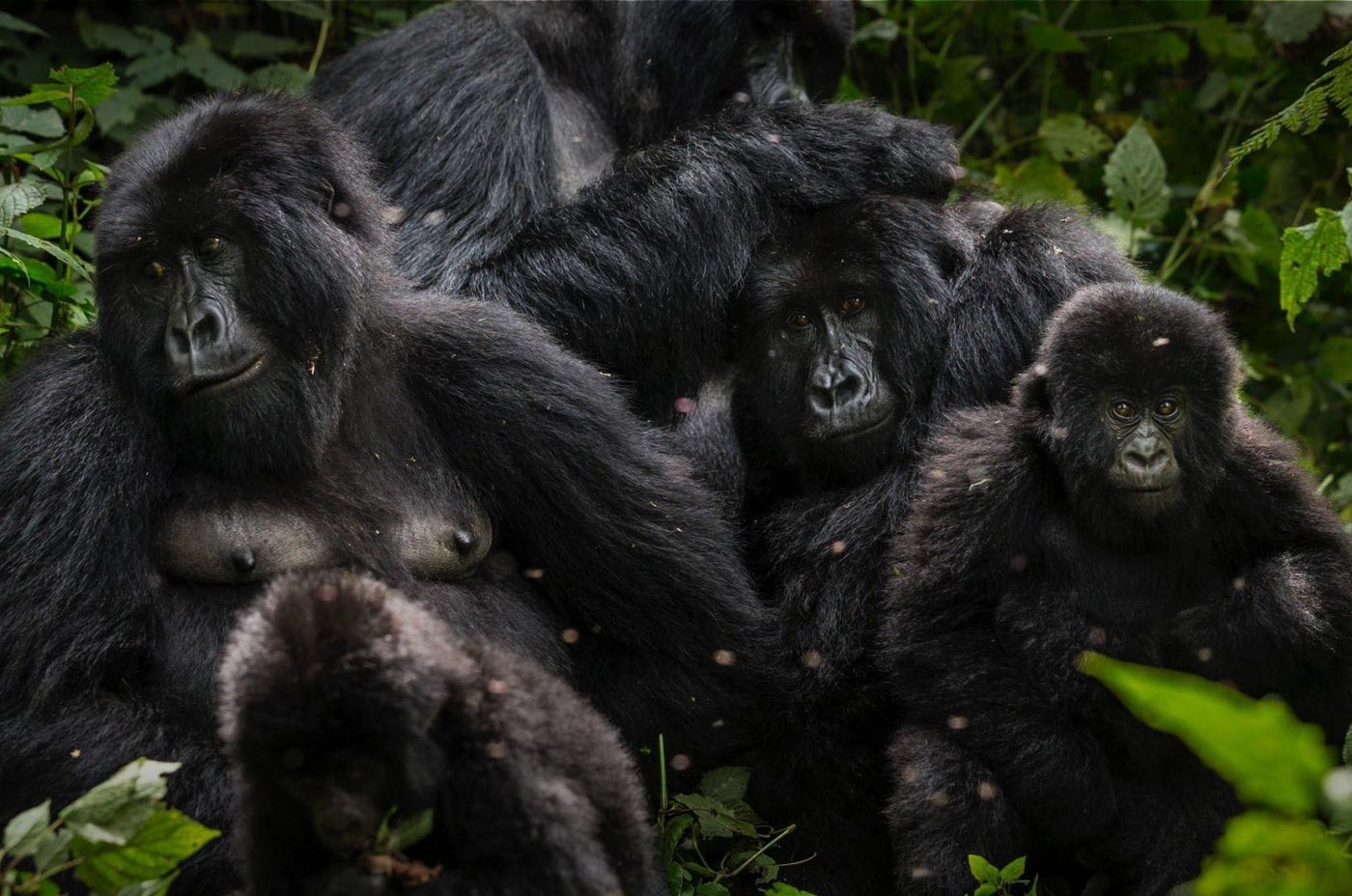
Meet the Families
So, who are these 12 families that let us barge into their living rooms for an hour?
You’ve got the celebrities, the overachievers, and the laid-back locals:
-
Susa A: Think of them as the Royal Family of gorillas. Dian Fossey herself studied this group back in the day. They live way, way up the mountain, so trekking to them is a lung-burning workout. But honestly? Standing in the clouds, watching them wrestle in the bamboo… it hits different.
-
Sabyinyo: These are the lazy neighbours. They usually hang out at lower altitudes, so if you’re not a hardcore hiker (or you’re nursing a sore knee), this is the family you secretly pray you get assigned to.
-
Agashya: This family has seen some stuff. They used to be called “Group 13,” but their silverback, Agashya, is such a rockstar leader that he basically rebranded the whole crew. He’s held them together through thick and thin.
-
Hirwa: This name means “Lucky One,” and honestly, they are. This family is the ultimate blended household—gorillas from totally different groups decided to bail on their old lives and merge into one big, happy, dysfunctional family. Tracking them is fascinating because their group dynamics are pure chaos in the best way.
-
Umubano & Amahoro: These two have history. Charles, a silverback, got fed up with the Amahoro family (whose name means “Peace”), packed his bags, and started his own group called Umubano (“Living Together”). It’s basically a soap opera about a family feud, except with more chest-beating.
And then you’ve got the Kwitonda, Bwenge, Ugenda (who are literally named after how much they move around—good luck finding them today!), and a few newer groups like Igisha and Muhoza that have just recently opened up to visitors.
The Elephant (or Gorilla) in the Room: Can You Pick Which One to See?
I know, I know—you’ve read a blog about Susa A, and you’re dead-set on seeing them. But on the morning of your trek, the rangers sit down with a map and a whiteboard. They look at you, look at the weather, and look at where the gorillas slept last night.
If you’re a 60-year-old who walks with a stick, they are not sending you up the volcano to chase the Karisimbi family. They’ll give you a group that’s closer to the trailhead. If you’re a marathon runner, they’ll give you the harder hike. It’s not favouritism—it’s safety and fairness. And honestly? I was gutted when I didn’t get my first choice. But an hour later, sitting five metres from a baby gorilla rolling down a hill, I forgot I ever wanted anything else.
Why Does the Number 12 Matter So Much for Your Gorilla Trek?
At first glance, “12” might seem like just another number in a travel brochure. But in the world of mountain gorilla trekking, it is the most critical number you need to know—and it dictates everything from your budget to your odds of actually securing a permit.
Here’s the raw, unfiltered reality of how gorilla trekking permits work in Volcanoes National Park:
The Daily Cap: Only 96 Visitors Per Day
To protect these endangered primates and maintain an intimate experience, the Rwandan government enforces a strict rule: only 8 visitors are allowed to visit each habituated gorilla family per day.
With only 12 habituated families currently open for tourism in the park, the math is brutally simple:
12 families × 8 visitors = just 96 people on the entire planet get to experience this each day.
That’s it. Out of 8 billion people, fewer than 100 walk those misty trails daily. This extreme scarcity is exactly why gorilla trekking permits cost between $1,500 and $2,500 and routinely sell out 6 to 12 months in advance—especially during the peak dry seasons of June–September and December–February. If you’re dreaming of a last-minute safari, you’re already fighting an uphill battle.
But Here’s the Silverback-Sized Silver Lining
While the permit price tag and the booking scramble can feel overwhelming, I’ll let you in on a secret: I’m actually grateful for the limit.
Why? Because when you’re finally there—hiking through the dense, volcanic bamboo forests, your boots caked in thick mud, and your heart pounding from the altitude—the strict cap pays off in spades. There are no jostling crowds. No loud chatter. No annoying selfie-sticks blocking your view (well, except for the one you’re holding).
Instead, you get something money can’t easily buy: pure, uninterrupted silence. You’ll hear the rhythmic thump of a silverback beating his chest, the gentle rustle of a mother adjusting her baby, and the steady drip of rainwater cascading off giant lobelia leaves.
Then, it happens. A massive, 400-pound silverback locks eyes with you from just a few feet away. He tilts his head, curiously sizing you up like you’re the strangest creature he’s encountered all week. In that fleeting, electric moment, you realize the strict limit isn’t a barrier—it’s a blessing. It preserves the magic, protects the gorillas, and ensures that your encounter feels less like a tourist attraction and more like a private audience with royalty.
The Unspoken Truth About Why We Really Do This
It’s easy to get caught up in the numbers. But here’s the part that hits you in the chest when you’re actually there: Every single dollar from that expensive permit goes straight back into protecting these guys.
That 12? Fifty years ago, that number was shrinking. Poachers, habitat loss, war—it was a grim picture. Today, because of tourism, those same forests are guarded by armed trackers 24/7. The local communities get a cut of the profits, so instead of poaching gorillas, they’re building schools and clinics.
So, while you’re worried about “Which family will I get?”—the gorillas don’t care. They don’t know they’re a “tourist group.” They’re just living their best lives, munching on celery-like plants, and occasionally giving us clumsy humans the side-eye.
My two cents? Stop sweating the exact number. Whether you get assigned to the famous Susa A or the lesser-known Muhoza, you will crawl back to your lodge covered in mud, utterly exhausted, with tears streaming down your face because you just watched a baby gorilla suck its thumb.
And that’s the whole point, isn’t it? It’s not about the stats. It’s about the hour that changes you.