


Hot Air Balloon Over the Great Migration: Full Guide and Cost
A hot air balloon safari over the Great Migration is widely considered one of the most exclusive and visually powerful wildlife experiences in Africa. While traditional game drives bring you close to animals at ground level, a balloon safari changes your perspective entirely. It allows you to observe the migration from above, revealing patterns, scale, and movement that are impossible to fully appreciate from a vehicle.
This experience is most commonly offered in two key ecosystems: Maasai Mara National Reserve and Serengeti National Park. These regions host the most dramatic phases of the migration, including river crossings, large herd concentrations, and predator-prey interactions.
For travelers planning a high-end safari in 2026, understanding how balloon safaris work, what they cost, and whether they are worth the investment is essential.
What a Hot Air Balloon Safari Actually Involves
A balloon safari is a sunrise activity that begins well before daylight. Guests are typically woken between 4:30 a.m. and 5:00 a.m., depending on the camp location and time of year. After a quick coffee or light snack, you are transferred by vehicle to the balloon launch site.
The pre-flight experience is part of the attraction. In the darkness of early morning, you watch as the balloon is inflated using powerful burners, gradually taking shape against the horizon as the sky begins to lighten. The process is calm, methodical, and carefully managed by trained ground crews.
Takeoff usually happens at dawn, just as the first light spreads across the plains. This timing is deliberate. Early morning offers the most stable air conditions and the most visually striking light for photography and viewing.
Once airborne, the balloon rises gently and begins drifting with the wind. Unlike aircraft, hot air balloons are not steered in a conventional sense. Instead, pilots adjust altitude to catch different wind currents, guiding the general direction of travel.
Flights typically last between 45 minutes and one hour, depending on weather conditions, wind speed, and landing logistics.
What You See From the Air
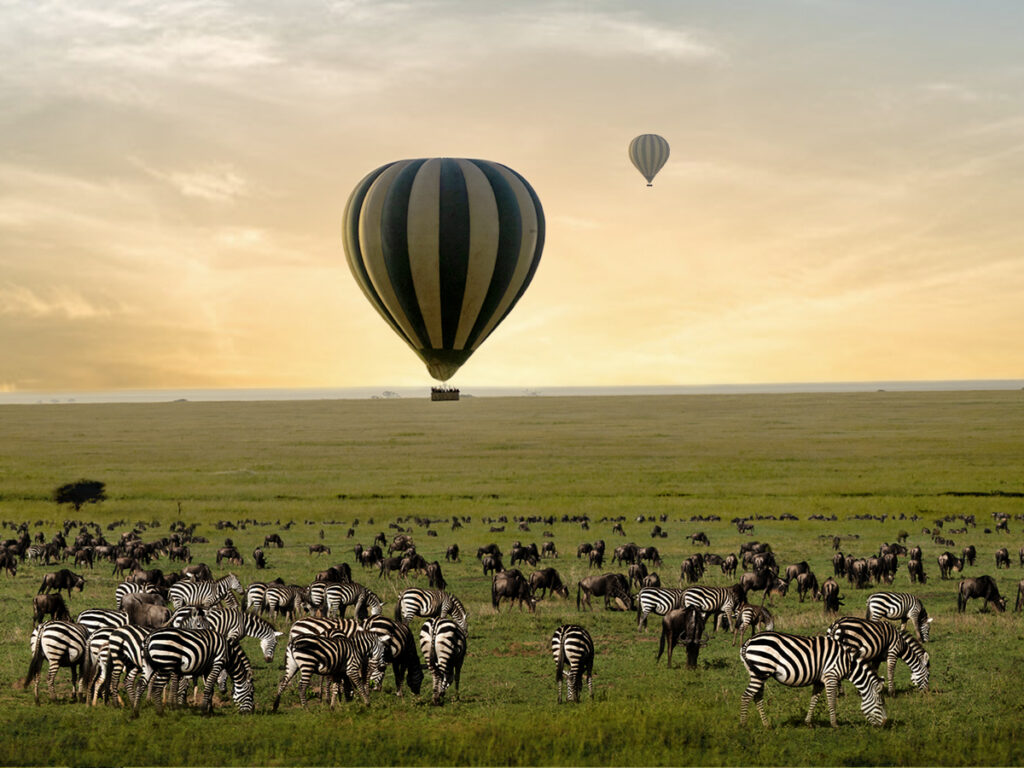
The defining feature of a balloon safari is perspective. From the ground, even large herds can feel fragmented. From the air, the migration becomes a single, continuous system.
You may see long lines of wildebeest stretching across the plains, clusters of zebra moving in coordinated patterns, or predators shadowing herds from a distance. Rivers, woodlands, and open savannahs form a natural map beneath you.
In areas near the Mara River, you can observe herd build-ups along riverbanks, where animals gather before attempting crossings. While witnessing an actual crossing from the air is rare due to timing and unpredictability, the pre-crossing tension and movement patterns are often visible.
Other wildlife is also part of the experience. Elephants, giraffes, buffalo, and antelope appear smaller from above but provide a broader ecological context. You begin to understand how different species share and use the landscape.
The silence of the experience is equally important. Aside from occasional bursts of the burner, the flight is quiet. There is no engine noise, no vehicle movement—just wind and open space.
The Landing and Bush Breakfast Experience
After landing, which is managed by a ground crew following the balloon, the experience continues with a bush breakfast.
This is not a simple meal. It is a fully set outdoor dining experience, often prepared in advance at a scenic location. Tables, chairs, linens, and service staff are arranged in the wilderness, creating a contrast between luxury and raw environment.
Breakfast typically includes eggs, sausages, fruit, pastries, coffee, tea, and sometimes sparkling wine. The “champagne breakfast” tradition dates back to early European ballooning culture and remains part of the safari experience today.
This meal is not rushed. It is designed as a social and reflective moment after the flight, allowing guests to discuss what they have seen while still surrounded by the landscape.
Cost of a Hot Air Balloon Safari in 2026
Balloon safaris are among the most expensive single activities on a safari itinerary, but the pricing reflects both operational complexity and exclusivity.
In 2026, standard shared balloon safaris generally cost between 450 and 600 US dollars per person.
Prices vary depending on several factors, including location, operator reputation, and season. Peak migration months—particularly July through October in the Maasai Mara—often command the highest rates due to demand.
Lower season pricing may be slightly reduced, especially in parts of the Serengeti where balloon safaris operate year-round.
The cost typically includes early morning transfers, the flight itself, professional pilot services, and the bush breakfast. However, park fees and accommodation costs are separate and can significantly affect the total safari budget.
Private balloon safaris are available at a much higher price point. These experiences are tailored for couples, families, or exclusive groups and can range from approximately 1,500 dollars to well over 5,000 dollars depending on group size and level of customization.
Why Balloon Safaris Are Expensive
The cost structure of balloon safaris is driven by several operational realities.
First, the equipment itself is specialized and expensive. Balloons require regular maintenance, safety inspections, and skilled pilots with specific certifications.
Second, logistics in remote safari areas are complex. Fuel, equipment, and food supplies must be transported to isolated locations, often over long distances.
Third, capacity is limited. Each balloon can carry only a small number of passengers, and only a few flights operate per day. This creates exclusivity but also drives up pricing.
Finally, safety standards are extremely high. Weather monitoring, ground crew coordination, and contingency planning all contribute to operational costs.
Best Time to Do a Balloon Safari Over the Migration
Timing is critical for maximizing the value of a balloon safari.
In the Maasai Mara, the best period is typically July to October, when large herds have moved north and river crossing activity increases.
In the Serengeti, balloon safaris can be done throughout the year, but the migration moves through different regions:
During the early part of the year, particularly between December and March, the migration gathers in the southern plains of Serengeti National Park, where calving season takes place and large numbers of newborns appear.
As the rains shift and grazing patterns change, the herds begin moving gradually through the central and western Serengeti from around April to June, spreading out as they search for fresh pasture.
Later in the year, typically from July through October, the migration pushes further north toward the river systems of the northern Serengeti, where dramatic river crossings become the defining event of this phase.
To get the most out of your balloon safari, your camp location must align with the current migration phase. This is a key planning consideration that many travelers overlook.
Who Should Consider a Balloon Safari
A balloon safari is best suited for travelers who value unique perspectives and premium experiences.
It is particularly popular among honeymoon couples due to its romantic setting and exclusivity. The combination of sunrise, silence, and champagne breakfast creates a memorable atmosphere that is difficult to replicate.
Photographers also benefit from the aerial viewpoint, especially for capturing patterns, landscapes, and herd movement. However, photographing from a balloon presents its own challenges, including limited stability and restricted angles.
First-time safari travelers often choose balloon safaris as a highlight activity, especially if they want a single standout experience beyond standard game drives.
Limitations and Considerations
Despite its appeal, a balloon safari is not without limitations.
Weather dependency is the most significant factor. Flights may be delayed or canceled due to wind conditions, and safety always takes priority.
The experience is relatively short, usually under one hour in the air, which can feel brief compared to full-day game drives.
There are also physical considerations. Guests must be able to climb into the basket and stand for the duration of the flight. Weight limits may apply depending on the operator.
Finally, while the aerial perspective is unique, it does not replace ground-based wildlife viewing. You will not get close-up detail or extended observation of specific animals.
Balloon Safari vs Traditional Game Drives
A common misconception is that a balloon safari can replace a game drive. In practice, the two experiences serve different purposes.
Game drives provide proximity, detail, and longer interaction with wildlife. You can follow animals, observe behavior, and adjust positioning.
Balloon safaris provide scale, context, and atmosphere. You see how the ecosystem functions as a whole, rather than focusing on individual animals.
The most effective safari itineraries combine both experiences, allowing you to understand the migration from multiple perspectives.
Is It Worth It?
Whether a balloon safari is worth the cost depends on your priorities.
If your focus is purely on wildlife quantity and close encounters, game drives deliver more value per dollar.
If your goal is to experience the migration in a unique and visually striking way, a balloon safari offers something that cannot be replicated on the ground.
For many travelers, it becomes one of the most memorable parts of the entire trip—not because of the duration, but because of the perspective and atmosphere.
Final Thoughts
A hot air balloon safari over the Great Migration is a premium, high-impact experience that transforms how you see Africa’s most famous wildlife event. It combines technical precision, logistical complexity, and natural beauty into a single, carefully orchestrated activity.
From the early morning launch to the silent flight over moving herds and the final bush breakfast in the wilderness, every element is designed to create a sense of exclusivity and immersion.
At 450 to 600 dollars per person in 2026, it is not a casual add-on. It is a deliberate investment in one of the most distinctive safari experiences available.
For travelers seeking more than just sightings—for those who want perspective, atmosphere, and a deeper understanding of the migration—it remains one of the strongest enhancements to a Great Migration safari itinerary.