


Great Migration and Bird Watching: 500 Species Along the Route
The Great Migration across Serengeti National Park and Maasai Mara National Reserve is typically framed as a story of wildebeest, zebras, and predators. Yet this vast ecological movement also supports one of Africa’s richest birding corridors. Along the migration route, over 500 bird species can be recorded, making it one of the most dynamic avian environments on the continent.
For bird watchers, this is not just a safari add-on. It is a full-scale, multi-habitat birding experience shaped by seasonal water availability, grassland cycles, and the presence of large herbivores.
Why the Great Migration Attracts So Many Bird Species
The migration creates a constantly shifting mosaic of habitats. As herds move, they alter vegetation structure, expose insects, fertilize soil, and open feeding opportunities for birds. This ecological disturbance is highly beneficial to avian diversity.
Short grass plains attract ground-feeding species and insectivores. River systems support waterbirds and raptors. Woodlands and acacia belts provide nesting and perching environments. Wetlands formed during rains become temporary hotspots for migratory birds.
The result is a layered ecosystem where different bird guilds overlap across seasons.
The Serengeti–Mara Birding Corridor
The migration route spans multiple ecological zones, each supporting distinct bird populations.
In the southern Serengeti plains, open grassland species dominate. These include bustards, larks, pipits, and coursers. During the calving season, insect activity increases, attracting swallows, bee-eaters, and other aerial feeders.
As the herds move toward central Serengeti, woodland and savannah species become more prominent. This region supports hornbills, barbets, rollers, and a variety of raptors.
The western corridor introduces riverine habitats, particularly along the Grumeti River. Here, kingfishers, herons, storks, and fish eagles are commonly seen.
In the northern Serengeti and into Maasai Mara, the Mara River system becomes the focal point. This area supports a high density of waterbirds and scavengers, particularly during river crossings.
Key Bird Groups Along the Migration Route
Raptors: The Aerial Predators
Birds of prey are among the most visible and ecologically important species along the migration route. The presence of large herbivores and frequent carcasses supports a strong raptor population.
Species commonly observed include:
Martial eagle
Bateleur eagle
African fish eagle
Secretary bird
Various vultures such as white-backed and lappet-faced
These birds play a critical role in maintaining ecological balance, particularly through scavenging.
Ground Birds of the Savannah
The open plains of Serengeti are ideal for ground-dwelling birds.
Key species include:
Kori bustard, one of the heaviest flying birds
Secretary bird, known for hunting snakes on foot
Various francolins and spurfowl
Coursers and sandgrouse
These species are well adapted to dry, open environments and are often seen during early morning game drives.
Waterbirds and Wetland Species
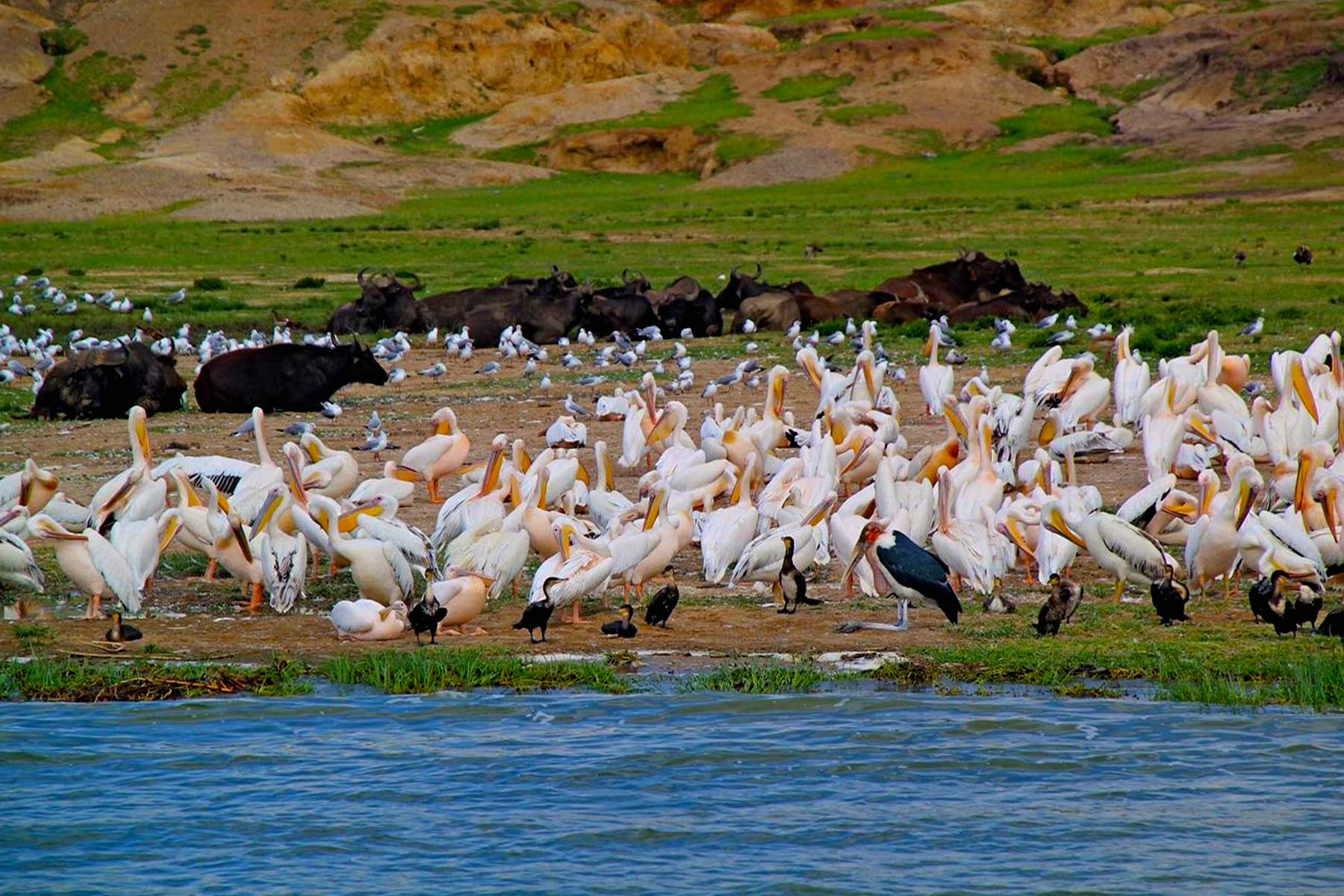
Seasonal rivers and wetlands attract a wide range of water-associated birds.
Common sightings include:
African jacana
Grey heron and goliath heron
Yellow-billed stork
Saddle-billed stork
Various kingfishers
These species are especially abundant during the wet season when water levels increase.
Colorful and Iconic Safari Birds
For many visitors, bird watching becomes memorable through visually striking species.
These include:
Lilac-breasted roller
Superb starling
Carmine bee-eater
Grey crowned crane
These birds are often seen perched along roadsides or in open woodland areas, adding vibrant color to the safari landscape.
Seasonal Birding and Migration Timing
Bird diversity along the Great Migration route is influenced by both local and international migration patterns.
From November to April, Palearctic migratory birds arrive from Europe and Asia. This significantly increases species diversity, particularly among smaller insectivores and waders.
During the dry season, resident species dominate, and visibility improves due to reduced vegetation cover.
The overlap between the wildebeest migration and bird migration creates peak birding opportunities, especially in the southern Serengeti during the wet season.
The Role of the Migration in Bird Ecology
The Great Migration is not just a backdrop for bird watching—it actively shapes bird behavior and distribution.
As herds graze, they flush insects into the air, creating feeding opportunities for aerial insectivores. Dung produced by herbivores supports insect populations, which in turn attract birds.
Carcasses from predation events provide food for vultures and other scavengers. This makes river crossing areas particularly important for raptor activity.
In essence, the migration creates a moving ecological engine that sustains bird life across the region.
Birding Techniques on Safari
Bird watching during a migration safari requires a slightly different approach compared to traditional game viewing.
Early morning is the best time for bird activity, as species are more vocal and active. Using binoculars enhances identification, especially for smaller or distant birds.
Listening is as important as looking. Many species are easier to detect by call than by sight.
Patience is essential. While large mammals draw attention, birding requires slowing down and observing details often missed during standard game drives.
Combining Big Game and Birding
One of the unique advantages of bird watching in Serengeti and Maasai Mara is the ability to combine it seamlessly with big game viewing.
You may observe:
Raptors circling above predator kills
Oxpeckers feeding on large mammals
Bee-eaters following moving herds
Storks and vultures gathering near carcasses
This interaction between birds and mammals creates a richer, more interconnected safari experience.
Why Bird Watchers Should Not Overlook the Great Migration
Many safari visitors focus exclusively on mammals, missing a significant part of the ecosystem.
For bird watchers, the migration route offers:
High species diversity in a single trip
Multiple habitats within one ecosystem
Seasonal variation that keeps sightings dynamic
Opportunities to observe ecological interactions
It is one of the few places where birding and large wildlife experiences are equally compelling.
The Great Migration across Serengeti National Park and Maasai Mara National Reserve is not only a spectacle of large mammals but also a major avian corridor supporting over 500 bird species.
For those willing to look beyond the obvious, the skies, riverbanks, and grasslands reveal a parallel migration story—one defined by flight, color, and constant adaptation.
Bird watching in this ecosystem is not separate from the migration. It is an integral part of it, offering a deeper and more complete understanding of one of Africa’s most complex natural systems.