


Full Moon and the Great Migration: Do River Crossings Increase at Night? (2026 Guide)
The idea that a full moon triggers dramatic nighttime river crossings during the Great Migration is one of the most persistent safari myths. It sounds logical on the surface. More moonlight means better visibility, which could make animals feel safer moving at night. Add in the mystery of nocturnal Africa and the appeal becomes even stronger. But when you look at how the migration actually works across ecosystems like Serengeti National Park and Maasai Mara National Reserve, the reality is more complex and far less predictable.
The short answer is this: there is no reliable scientific or field-based evidence showing that full moons significantly increase river crossings at night. Most crossings still happen during daylight hours, and the factors that trigger them have very little to do with lunar phases.
Understanding How River Crossings Actually Happen
To understand why the full moon theory does not hold up, it is important to first understand how crossings occur.
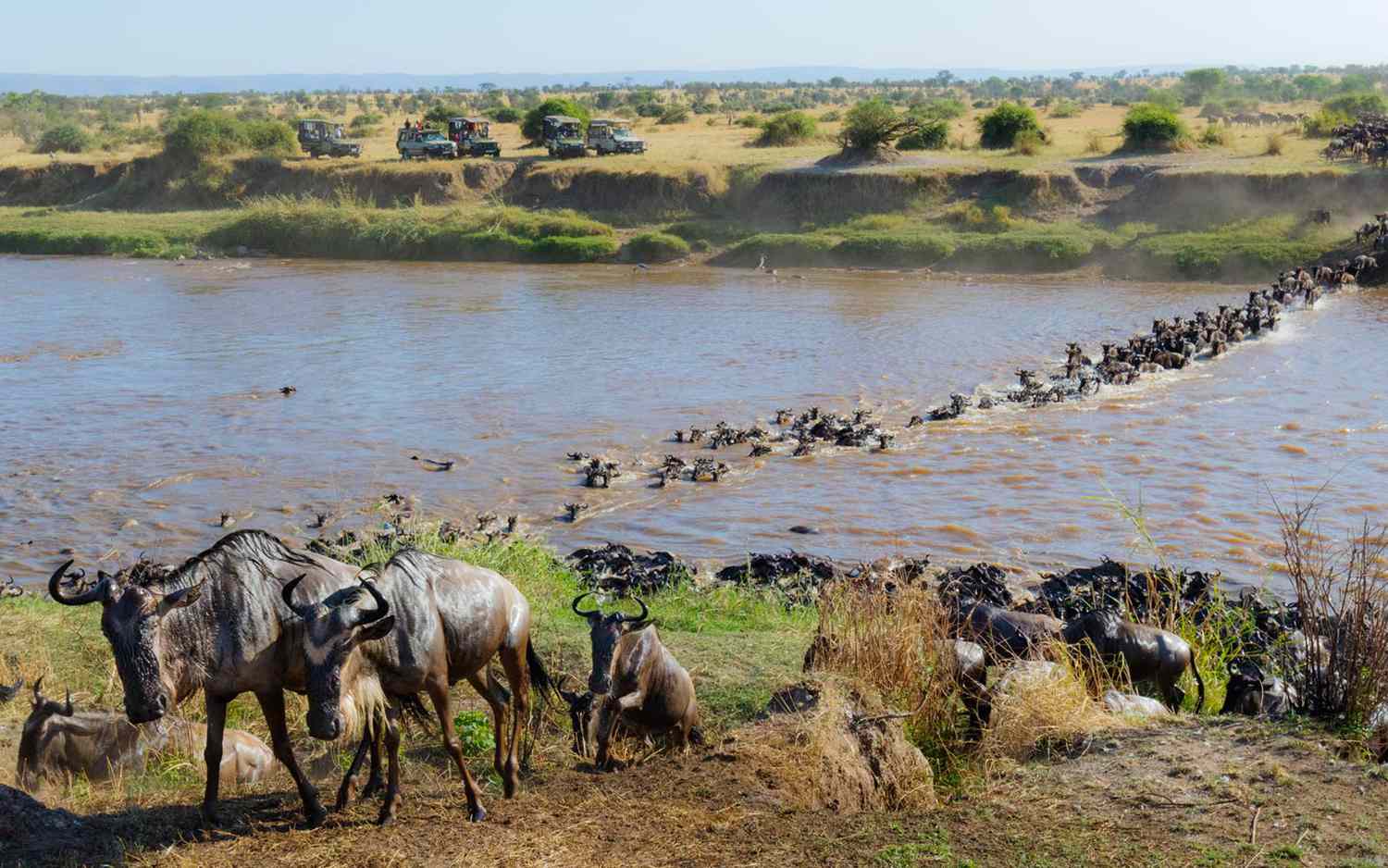
Wildebeest do not follow a schedule. They respond to immediate environmental pressures. Herds may gather at a riverbank for hours or even days, building tension as they hesitate. The decision to cross is often triggered by a combination of herd density, pressure from animals behind them, predator presence, thirst, and instinctive movement patterns.
When one animal finally jumps, it can trigger a chain reaction. Within seconds, thousands follow. This process is chaotic and unpredictable, and it does not depend on the time of day in a consistent way.
While crossings can technically happen at any time, they overwhelmingly occur during daylight. This is not because of the moon, but because of how wildebeest behavior and environmental cues align during the day.
Why Daytime Crossings Are More Common
Daylight provides visual cues that help wildebeest assess risk. Even though they are not highly intelligent animals, they rely heavily on sight and herd behavior. During the day, they can see the movement of others, identify entry and exit points, and respond to group dynamics more effectively.
Temperature also plays a role. Movement tends to increase during cooler parts of the day, such as early morning and late afternoon. These periods often coincide with peak crossing activity.
Another important factor is predator visibility. While crocodiles are present at all times, visibility above the waterline is better during daylight, which may influence herd hesitation and decision-making.
These combined factors naturally make daytime the most active period for crossings.
The Role of the Full Moon in Animal Behavior
The full moon does influence animal behavior in general, but not always in the way people expect.
In many ecosystems, increased moonlight can actually reduce activity among prey species because predators can see them more easily. Some animals become more cautious during bright nights rather than more active.
For predators, a full moon can improve hunting visibility, but it can also make ambush more difficult because prey can detect movement more easily. This creates a balance where neither predators nor prey behave in a dramatically different way that would trigger large-scale events like river crossings.
In the case of wildebeest, there is no consistent pattern showing increased movement or river crossing activity tied directly to lunar cycles.
Do Night Crossings Ever Happen?
Yes, night crossings do occur, but they are rare and largely undocumented in the way daytime crossings are.
The main reason is not that they never happen, but that they are difficult to observe. Safari regulations in both Serengeti National Park and Maasai Mara National Reserve generally restrict night driving in core areas. This means most visitors and guides are not present to witness or record these events.
Even when night crossings occur, they are unlikely to match the scale and visual impact of daytime events. Without sunlight, the dramatic elements that define a crossing—dust, splashing water, visible predator attacks—are much harder to perceive.
From a practical standpoint, even if crossings were slightly more likely at night, they would not offer the same safari experience.
Why the Full Moon Myth Persists
The belief that full moons increase river crossings persists for several reasons.
First, it is an appealing narrative. It adds a sense of timing and predictability to an otherwise unpredictable phenomenon. Travelers naturally want to maximize their chances of seeing a crossing, and the idea of aligning a safari with a full moon feels like a strategy.
Second, the full moon does influence some aspects of wildlife behavior, which leads to generalizations. People assume that because the moon affects animals, it must also affect migration events.
Third, marketing and storytelling sometimes amplify this idea. It is easier to sell a safari experience when it appears to have a “perfect timing” formula.
However, experienced guides and long-term field observations consistently show that river crossings are driven by immediate environmental conditions rather than lunar cycles.
What Actually Increases Your Chances of Seeing a Crossing
If the full moon is not a reliable factor, what should you focus on instead?
Location is the most important element. Staying near active river crossing points in the northern Serengeti or Maasai Mara during peak months increases your exposure to potential events.
Time spent in the field is equally critical. The more days you spend near crossing areas, the higher your chances of witnessing a crossing. This is why multi-day stays are strongly recommended.
Guide expertise also plays a major role. Experienced guides track herd movement, monitor patterns, and communicate with other guides to position you effectively.
Flexibility is another key factor. Being willing to adjust your schedule and respond to real-time information increases your chances of being in the right place at the right time.
None of these factors involve the moon.
The Real Nature of the Migration Experience
Focusing too heavily on river crossings, whether tied to the full moon or not, can limit your overall safari experience.
The Great Migration is not defined by a single event. It is a continuous system involving calving, grazing, predator interaction, and long-distance movement. Each phase offers unique opportunities to observe wildlife behavior.
Many travelers who miss crossings still report extraordinary experiences, including close predator encounters, large herd movements, and intimate wildlife moments that are just as memorable.
The unpredictability of the migration is part of its appeal. It is not a performance that can be scheduled or controlled.
A More Realistic Way to Plan Your Safari
Instead of trying to time your safari around a full moon, focus on broader seasonal patterns and practical considerations.
Choose the right migration phase based on what interests you most. Allocate enough time in key areas to increase your chances of meaningful sightings. Work with experienced guides who understand the ecosystem and can adapt plans as conditions change.
By focusing on these factors, you improve your overall safari experience rather than chasing a specific moment that cannot be guaranteed.
Final Thoughts
The idea that full moons increase nighttime river crossings during the Great Migration is more myth than reality. While the moon does influence certain aspects of animal behavior, it does not play a decisive role in triggering large-scale crossing events.
Across landscapes like Serengeti National Park and Maasai Mara National Reserve, river crossings remain unpredictable, driven by immediate environmental conditions rather than lunar cycles.
If you are planning a migration safari, your focus should be on timing within the season, location, guide expertise, and time spent in the field. These are the factors that genuinely increase your chances of witnessing one of nature’s most dramatic events.
In the end, the Great Migration is powerful not because it follows a predictable pattern, but because it does not.