
Volcanoes National Park, Rwanda: Everything You Need to Know
Volcanoes National Park is one of those places that feels simple on a map but very different once you are actually there. It sits in the northwestern corner of Rwanda, close to the borders of Uganda and the Democratic Republic of Congo, inside the Virunga mountain range. The landscape rises sharply into volcanic peaks covered in dense forest, often wrapped in mist.
This is not a park where you drive long distances watching wildlife from the vehicle. It is a place where you step out, walk into thick vegetation, and follow trained guides into the habitat of mountain gorillas. Everything here is built around that experience.
What makes it stand out is not only the animals. It is how controlled, structured, and focused the entire system is. You do not roam freely. You move with purpose, guided by trackers who already know where the gorillas are. That structure shapes every part of the visit.
Where the park is and what it looks like
The park lies in the northwest of Rwanda near the town of Musanze. From Kigali, the drive takes around two to three hours depending on traffic and weather. The road is smooth for most of the journey, then becomes more scenic as you approach the volcanic region.
As you get closer, the landscape changes quickly. You start seeing hills covered in farmland, then taller green slopes, then finally dense forest climbing the volcanoes. On clear days, you may see multiple peaks in the Virunga chain. On cloudy days, the mountains disappear into mist.
The altitude is high. This affects temperature and walking conditions. It feels cooler than Kigali, and weather can shift without warning.
The park is part of a wider ecosystem shared with Uganda’s Bwindi region and Congo’s Virunga area, which is important for mountain gorilla survival.
Why Volcanoes National Park is important
This park is one of the last remaining strongholds of mountain gorillas in the world. Their survival depends on protected forest areas like this one.
Conservation work here has been ongoing for decades. At one point, mountain gorillas were critically endangered. Their numbers were very low, and habitat loss was a major threat.
Today, their population has slowly increased due to strict protection, controlled tourism, and community involvement.
Tourism plays a direct role in this system. Every permit sold supports ranger salaries, conservation projects, and local community programs around the park.
Without this system, the gorilla population would be far more vulnerable.
Gorilla trekking process explained
Gorilla trekking is the main activity in the park. The process is highly organized and starts early in the morning.
You arrive at the park headquarters near Kinigi before sunrise. The atmosphere is calm but structured. Visitors gather in an open area while staff handle registration and group assignments.
Each group is assigned to a specific gorilla family. This is based on location, fitness levels, and group size. The aim is to distribute visitors evenly across the forest.
After the briefing, you are driven closer to the starting point. This short transfer brings you to the edge of the forest or nearby trailheads.
From there, the trekking begins.
The walk into the forest
The first part of the walk often passes through farmland or open areas near the park boundary. This gives a brief transition from human settlements into wilderness.
As you enter the forest, the environment changes immediately. Vegetation becomes thicker. The ground becomes softer and more uneven. Trees grow closer together, and visibility decreases.
You are now inside the natural habitat of mountain gorillas.
The pace is steady. Guides move ahead, clearing the way and watching for signs. You follow closely, staying within the group.
There is no fixed path. Gorillas move freely, so the route changes every day depending on their location.
Some treks are short and manageable. Others involve several hours of climbing and walking through steep terrain.
How trackers find gorilla families
Before tourists enter the forest, a team of trackers goes out early in the morning. Their job is to locate the gorilla families and report their position.
They use signs like nests, feeding patterns, and movement trails. Over time, these families become well known, so their general movement patterns are predictable.
Once a group is found, communication is sent back to the rangers guiding visitors. This allows the trekking groups to move in the right direction instead of searching blindly.
This system increases the chances of successful sightings and reduces unnecessary disturbance in the forest.
The moment you reach the gorillas
The experience changes completely once you are close.
The guides slow down the group. Instructions become quieter. Movement becomes careful.
Then you stop.
A ranger signals that the gorillas are nearby.
You take a few more steps forward.
And suddenly they are there.
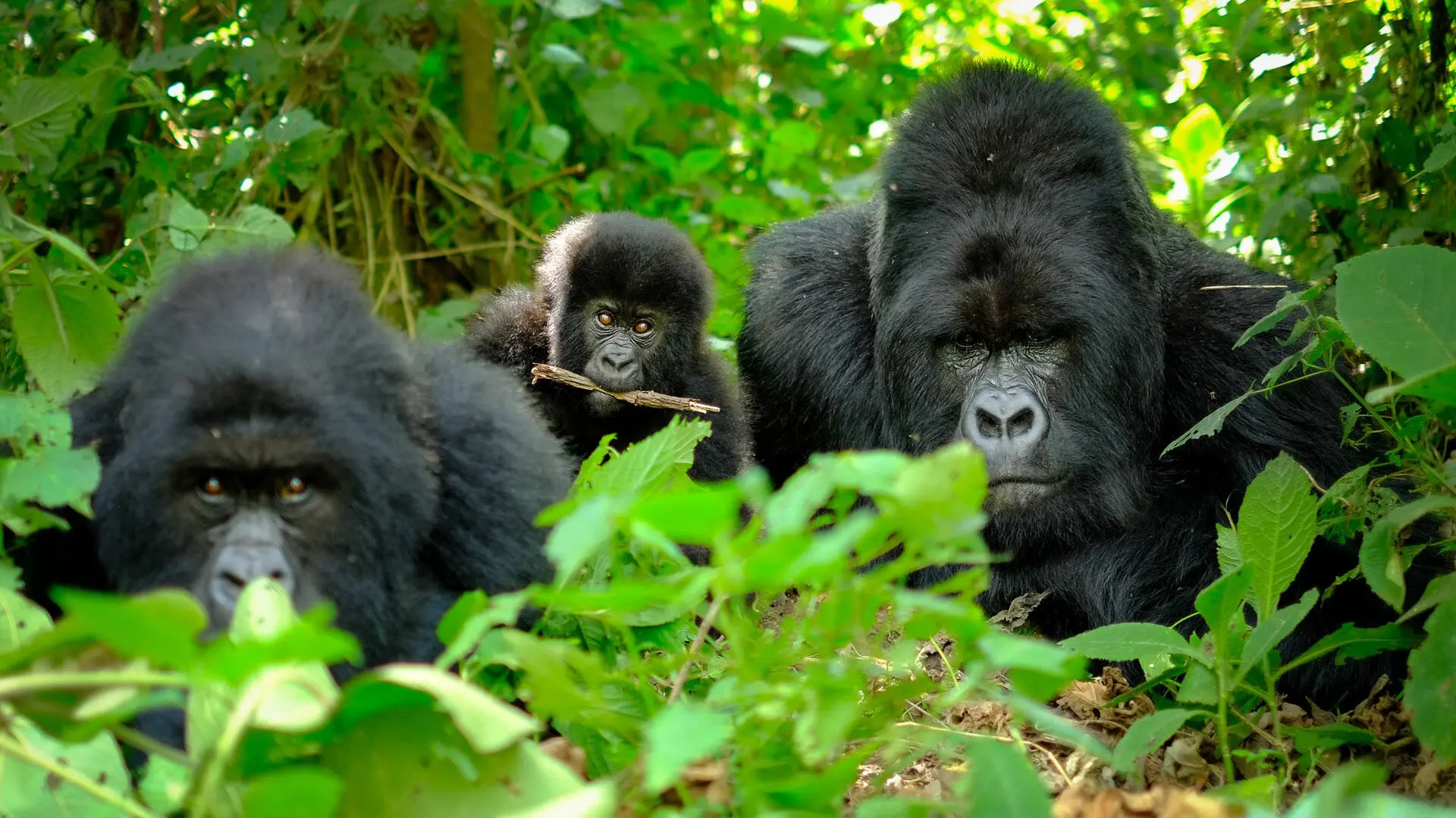
A silverback sits in the vegetation, large and calm, watching quietly. Nearby, females feed or rest while keeping infants close. Young gorillas move briefly, then settle again.
There is no chaos. No sudden reaction. No sense of alarm.
You are simply observing a family going through its normal day.
Most people stop talking at this point. Not because they are told to, but because the moment naturally creates silence.
What you observe during the one-hour visit
Visitors are allowed to spend one hour with the gorilla family once they are found.
This time limit is strictly enforced in Volcanoes National Park to protect the animals and reduce stress.
During that hour, you observe behavior rather than action. You watch how the group interacts internally.
The silverback often remains still, observing the surroundings. Females move slowly while feeding or resting. Infants stay close to their mothers, sometimes clinging tightly.
Young gorillas are more playful. They climb, interact, and move quickly before returning to the group.
What stands out is how natural everything feels. There is no performance. No change in behavior because humans are present. The gorillas continue their routine.
The experience becomes about patience and attention to detail.
Physical challenge and terrain
Gorilla trekking in Rwanda can be physically demanding, but difficulty varies from day to day.
Some treks are relatively short and involve gentle walking. Others require steep climbs through volcanic slopes, dense vegetation, and uneven ground.
Altitude plays a role as well. You are often walking at high elevation, which affects breathing and stamina.
The pace is slow but steady. Guides adjust based on group ability.
Many visitors choose to hire porters. This helps carry bags and offers support on steep or slippery sections. It also supports local livelihoods around the park.
Fitness helps, but mindset matters more. Walking carefully and pacing yourself makes the experience manageable for most people.
Weather and seasonal conditions
The park has a mountain climate. Temperatures are cooler than in Kigali, and weather can change quickly.
Rain can fall at any time, especially in higher areas of the forest. This affects trail conditions, making them muddy and slippery.
There are two main dry seasons when trekking conditions are generally easier. Trails are firmer and visibility can improve slightly.
Wet seasons bring heavier rainfall, but also greener landscapes and fewer crowds.
Gorilla sightings remain consistent throughout the year because tracking happens daily regardless of season.
Other activities in the park
While gorilla trekking is the main attraction, there are other activities available.
Golden monkey tracking is a popular option. These monkeys are more active and move quickly through bamboo forests. The experience feels faster and more energetic compared to gorillas.
Hiking Mount Bisoke is another option. This volcanic peak has a crater lake at the top and offers wide views over the surrounding region. The hike is more physically demanding but rewarding in terms of scenery.
Cultural visits around the park provide insight into local communities. These experiences show how conservation and tourism support livelihoods in the surrounding areas.
Accommodation around the park
Most visitors stay near Musanze or Kinigi. The area has a range of accommodation options, from basic guesthouses to high-end lodges.
Many lodges are designed to support early morning departures. Since trekking starts early, staying close to the park reduces travel time and makes the experience smoother.
Some lodges also offer views of the volcanoes, especially on clear mornings when the peaks are visible above the mist.
Conservation impact
The park plays a key role in mountain gorilla conservation.
Tourism revenue supports ranger teams, veterinary care, and habitat protection. Strict rules during trekking help limit human impact on the gorillas.
These measures have contributed to gradual population recovery over time.
The system is tightly managed because the species remains vulnerable despite progress.
Volcanoes National Park is not defined by variety of wildlife. It is defined by one rare and carefully protected experience.
The structure is controlled, the environment is demanding, and the encounter with gorillas is short but focused.
What stays with most visitors is not the hike itself, but the moment they stand in front of a gorilla family and realize how calm everything becomes.
There is no rush, no noise, and no performance. Just a quiet view into a world that continues independently of you.
That is what makes this park one of the most important wildlife destinations in Africa.