What’s Unique About Mgahinga’s Volcanoes?
An In-depth Look at Uganda’s Lesser-Known, Dramatic Peaks with Great Migration Adventure
Nestled in the far southwestern corner of Uganda, where the borders of Uganda, Rwanda, and the Democratic Republic of Congo meet, lies a hidden gem of remarkable geological and ecological significance: Mgahinga Gorilla National Park. While most visitors know it as a compact and dramatic setting for gorilla tracking, fewer understand the sheer uniqueness of the three volcanic peaks that dominate its skyline: Mount Muhabura, Mount Gahinga, and Mount Sabyinyo.
At Great Migration Adventure, we believe that travel should not only show you the “Big Five” or the usual checklist of species, but immerse you in stories of land, culture, and evolution. Mgahinga’s volcanoes offer just that—a mysterious trio of ancient giants that reveal the secrets of Africa’s geological past, biodiversity hotspots, and spiritual cultural narratives.
Let us take you deep into the heart of these dramatic peaks and explore what makes Mgahinga’s volcanoes truly unique.
1. The Virunga Volcanoes: A Geological Marvel
Mgahinga is part of the legendary Virunga Volcano Range, a chain of eight major volcanoes stretching across Uganda, Rwanda, and the DRC. The three that fall within Uganda’s Mgahinga Park are:
-
Mount Muhabura (4,127m)
-
Mount Gahinga (3,474m)
-
Mount Sabyinyo (3,645m)
These volcanoes are all extinct or dormant, having last erupted over 10,000 years ago. Their rugged forms, steep flanks, and weathered calderas tell a story of epic tectonic activity. The creation of these volcanoes is linked to the East African Rift System, a tectonic divide that’s slowly tearing the continent apart, giving rise to mountains, valleys, lakes—and these volcanoes.
What makes Mgahinga’s section especially unique is that it offers a microcosm of the entire Virunga range, packed within just 33.7 square kilometers. Here, in one compact and navigable area, travelers can experience three different volcanic environments: Muhabura’s steep cone and crater lake, Gahinga’s moorland and bamboo zones, and Sabyinyo’s rugged, jagged summit.
2. Distinct Mountain Experiences: Choose Your Climb
Each of the three volcanoes offers its own character—and its own rewards for those who dare to hike them.
Mount Muhabura: “The Guide”
Muhabura means “the guide” in Kinyarwanda and local Bafumbira languages. Towering above the landscape at 4,127 meters, it’s the highest in Mgahinga and the second-highest in the entire Virunga chain.
Hiking Muhabura is not for the faint-hearted. It’s a steep, direct ascent across moorlands and rock fields, culminating at a dramatic crater lake at the summit. On a clear day, you can see five countries from the top: Uganda, Rwanda, the DRC, Tanzania, and even Kenya’s Mount Elgon on the horizon. The climb takes 8–10 hours round trip and requires good fitness—but the views and the surreal silence atop an ancient volcano are absolutely worth it.
Mount Gahinga: “The Pile of Stones”
Smaller and gentler than its neighbors, Gahinga is perfect for those seeking a more leisurely volcanic hike. Its name comes from the Bafumbira word for the piles of volcanic stones farmers often clear from their fields.
At 3,474 meters, Mount Gahinga is cloaked in dense bamboo forests, making it a top location for spotting the endangered golden monkeys. It’s also rich in birds and rare mountain flora. At the top, you’ll find a swampy caldera that is often veiled in mist—an otherworldly and quiet contrast to the fierce grandeur of Muhabura.
Mount Sabyinyo: “Old Man’s Teeth”
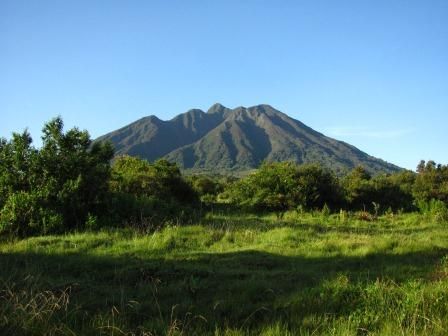
Mount Sabyinyo is perhaps the most iconic of the three. Nicknamed “Old Man’s Teeth” due to its serrated summit, it offers a rugged, technical climb that straddles three countries. When you stand on its highest peak, you are in Uganda, Rwanda, and the DRC—all at once.
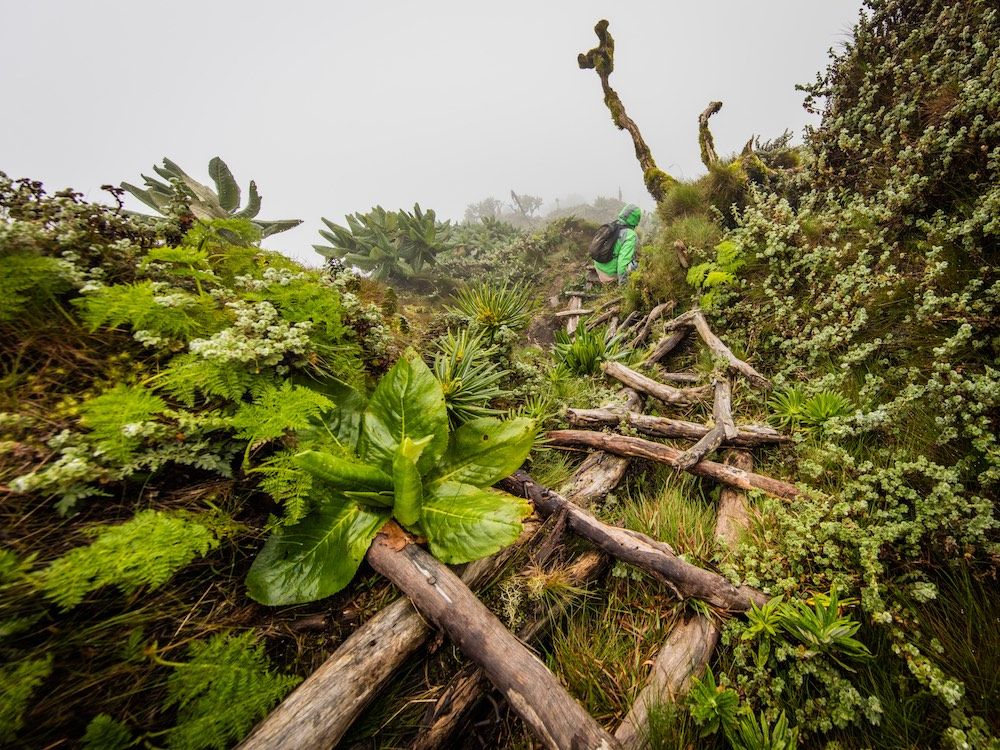
The hike to Sabyinyo is not just a physical challenge; it’s a border-crossing adventure. With wooden ladders fixed over sharp ridges and narrow ledges, it’s the kind of climb that leaves your heart racing. But standing on the tri-border point is a spiritual experience like no other—one that truly encapsulates Mgahinga’s uniqueness.
3. Biodiversity: From Afro-Alpine Plants to Golden Monkeys
Mgahinga’s volcanoes host a stunning array of biodiversity packed into dramatic altitude gradients. From the lower montane forests to the alpine zones, hikers and nature lovers encounter a sequence of ecosystems rarely found in one park.
-
Bamboo Forests: Ideal for spotting golden monkeys, a playful and critically endangered primate species that thrives in the bamboo zones of Gahinga and Sabyinyo.
-
Moorlands and Lobelias: Higher elevations on Muhabura and Sabyinyo feature vast moorlands dotted with giant lobelias and groundsel, flora adapted to the harsh alpine climate.
-
Birding Haven: The volcanoes are home to over 180 bird species, including the Rwenzori turaco, dusky crimsonwing, and Ruwenzori batis. For serious birders, Mgahinga is a paradise of endemics and rarities.
4. Cultural Connections: Sacred Peaks and Ancient Traditions
To the indigenous Batwa people, the volcanoes are sacred. These forest-dwelling hunter-gatherers lived in the slopes and caves of the Virungas for centuries before conservation policies forced their resettlement. However, the spiritual significance of the volcanoes remains central to their cultural identity.
At Great Migration Adventure, we include the Batwa Trail Experience in our Mgahinga safaris. This interactive journey led by Batwa elders explores ancient caves, hunting paths, and traditional medicine plants on the forested slopes of the volcanoes. Few places on earth offer such a blend of natural wonder and living heritage.
5. Peace and Solitude: The Anti-Crowd Experience
Mgahinga sees far fewer visitors than its more famous cousin, Bwindi Impenetrable National Park, even though both offer gorilla tracking. What does this mean for you?
-
Peaceful Trails: You’ll likely hike the volcanoes without meeting another soul.
-
Authentic Encounters: Whether it’s with wildlife or local guides, every experience feels personal and unhurried.
-
Exclusive Photography: Without the distraction of crowds, photographers can capture mist-shrouded summits, monkey families, and spiritual rituals in perfect serenity.
For Great Migration Adventure clients, this means an authentic, off-the-beaten-path journey. It’s not just a volcano trek—it’s a soul-resetting encounter with earth, history, and heritage.
6. Logistics: How to Visit Mgahinga’s Volcanoes with Great Migration Adventure
We tailor each volcano adventure to your fitness, interests, and safari timeline. Here’s how we make it easy:
-
Private Transfers: From Entebbe or Kigali, we handle all logistics with 4×4 Land Cruisers and experienced driver-guides.
-
Permits & Gear: We secure all hiking permits, gorilla tracking options, and offer gear rentals (walking sticks, rain ponchos, etc.).
-
Comfortable Base: We use cozy eco-lodges in Kisoro or inside the park like Mount Gahinga Lodge, which offers volcano views right from your window.
-
Custom Add-ons: Combine volcano hikes with gorilla trekking, golden monkey tracking, canoeing on Lake Mutanda, or community visits.
7. Best Time to Climb the Volcanoes
Mgahinga’s volcanoes are climbable year-round, but we recommend:
-
June to August and December to February: Drier months with better trail conditions and clearer summit views.
-
March–May and September–November: Lusher vegetation, but steeper slopes may be slippery—best tackled by experienced hikers.
The early mornings always offer the clearest weather and most dramatic photography light. We structure hikes to start early, with packed lunches and ample stops for rest and exploration.
8. Safety & Conservation Practices
At Great Migration Adventure, we’re deeply committed to safe and sustainable volcano adventures.
-
Trained Guides: Our guides are not only licensed but deeply knowledgeable in high-altitude terrain and first aid.
-
Community Partnerships: A portion of every volcano trek we operate supports local conservation and community health programs in Kisoro.
-
Zero Impact Policy: We promote leave-no-trace hiking and avoid wildlife disturbance, especially in the fragile alpine zones.
9. Why Mgahinga’s Volcanoes Matter Today
Beyond their beauty, Mgahinga’s volcanoes represent the delicate balance between conservation and culture, between wild isolation and interlinked communities. In a world where overtourism threatens even the most remote places, Mgahinga stands as a model of harmony—a place where the echoes of ancient eruptions coexist with human songs and forest whispers.
With the climate crisis intensifying and global interest in slow travel growing, destinations like Mgahinga are not only rare—they’re essential. They remind us of Earth’s power, resilience, and the stories written into stone and sky.
Final Thoughts: Volcanoes Worth the Climb
Mgahinga’s volcanoes are not for every traveler—but they’re perfect for the right kind. If you seek more than selfies and soundbites—if you’re drawn to silence, challenge, discovery, and truth—then these peaks are calling.