

Lake Manyara National Park: Tanzania’s Hidden Gem of Contrasts
There is a place in Tanzania where the Rift Valley escarpment rises like a great wall from the earth, where flamingos paint the lake in shades of pink, and where lions—yes, lions—lounge lazily in the branches of acacia trees. This is Lake Manyara National Park, a compact yet breathtakingly diverse safari destination that many travelers overlook in their rush to the Serengeti and Ngorongoro . But those who stop here discover something magical: a microcosm of Tanzania’s wild beauty packed into just 648 square kilometers .
Manyara is not trying to compete with its famous neighbors. It is simply being itself—a place of extraordinary contrasts, where groundwater forests meet soda lakes, where elephants move silently through mahogany trees, and where the drama of the wild unfolds in intimate, unexpected ways.
🌍 Lake Manyara at a Glance: Your Quick Inspiration Table
| What | Details |
|---|---|
| Location | Northern Tanzania, at the base of the Great Rift Valley escarpment, near Mto wa Mbu |
| Area | Approximately 648.7 km², with the alkaline lake covering about two-thirds to three-quarters of the park |
| Established | Originally a game reserve in 1957; became a national park in 1960 |
| Best Time to Visit | Dry season (June–October) for large mammals; wet season (November–May) for birdwatching |
| Distance from Arusha | ~125 km, about 2–2.5 hours by road |
| Nearest Airport | Lake Manyara Airstrip (scheduled/charter flights); Kilimanjaro International Airport ~40 km |
| Famous For | Tree-climbing lions, flamingos, groundwater forests, Rift Valley escarpment |
| Wildlife | Elephants, lions, leopards, buffalo, giraffe, zebra, hippos, baboons, blue monkeys, flamingos |
| Bird Species | 390–400+ recorded species |
| Entry Fee | $70 USD international adults; $20 USD international children |
🦁 The Tree-Climbing Lions: Manyara’s Signature Mystery
Lake Manyara is the only place in Tanzania where lions routinely lounge in tree branches—a behavior that remains one of Africa’s most intriguing wildlife mysteries . Unlike leopards, who climb trees instinctively, lions are ground-dwelling predators. Yet here, in the southern acacia forests of Manyara, entire prides have been observed draped across limbs like oversized house cats .
Why do they do it? Scientists have proposed several theories: escaping biting insects, catching the breeze to stay cool, or gaining a vantage point to spot prey . The truth is, no one knows for certain. What is certain is that seeing a lion in a tree is an unforgettable experience—one that feels almost surreal.
A note for the hopeful: Tree-climbing lion sightings have become increasingly rare in recent years . Your best chance is in the southern part of the park, especially during the dry season when vegetation is thinner . Even if you don’t see one, the search itself—scanning the branches, hoping for a glimpse of tawny fur against green leaves—is part of the adventure.
🦩 Flamingos and the Pink Lake
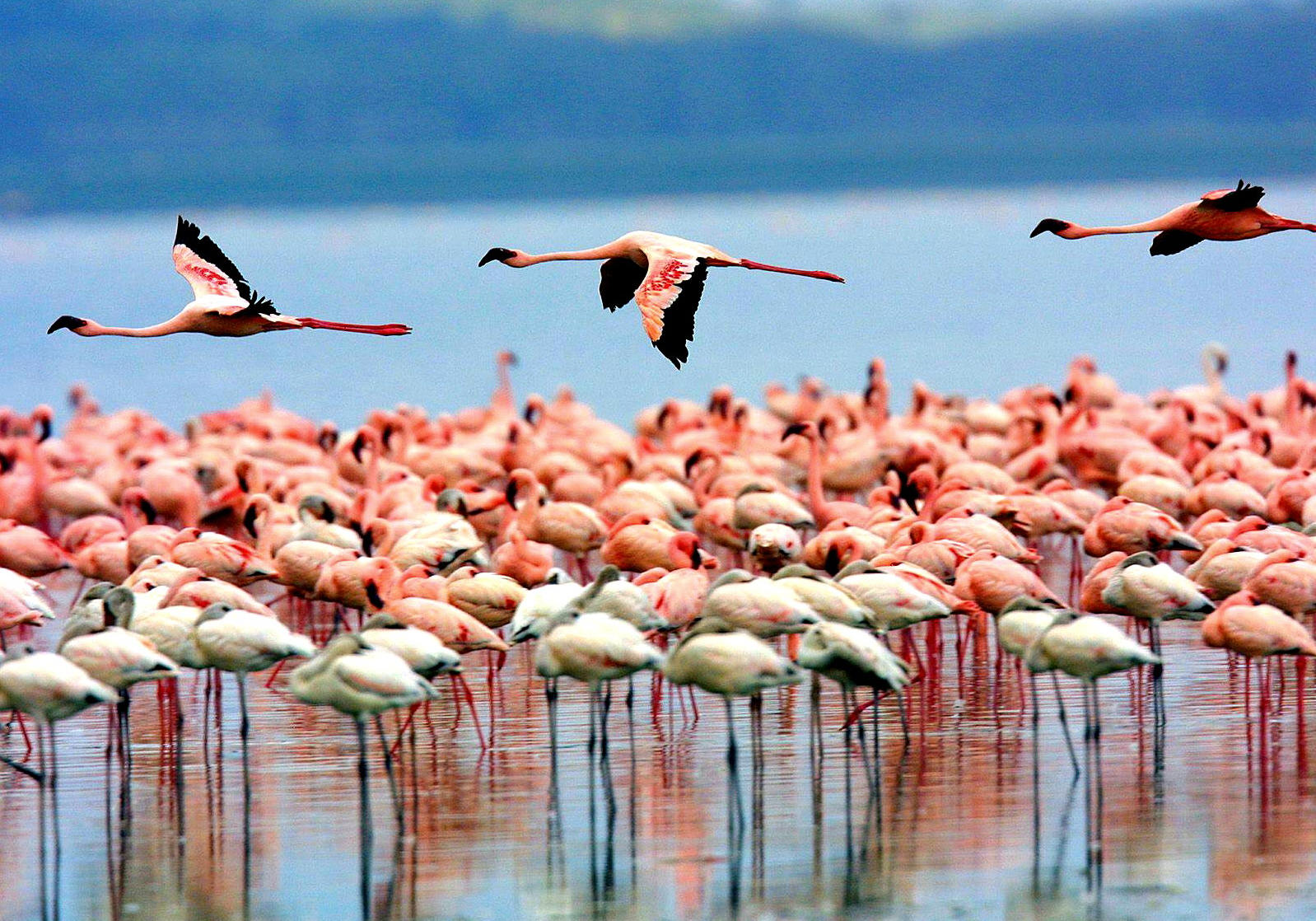
The alkaline waters of Lake Manyara are a feeding ground for thousands of lesser flamingos, whose presence turns the shoreline into a shimmering ribbon of pink . These elegant birds filter algae and brine shrimp from the shallow water, standing on one leg in a ballet of patience and grace.
| Flamingo Facts | Details |
|---|---|
| Species | Greater and lesser flamingos |
| Best Time to See Them | Year-round, with peak numbers in wet season (November–May) |
| Why They’re Pink | Pigments from the algae and shrimp they eat |
| Other Waterbirds | Pelicans, cormorants, storks, herons, egrets |
When the flamingos take flight, the sky fills with a cascade of pink and black feathers. It is one of those moments that reminds you why you travel.
🌳 The Groundwater Forest: A Secret World
Just beyond the lake, a lush groundwater forest thrives—fed by underground springs that flow from the Rift Valley escarpment . Towering mahogany and fig trees create a canopy so dense that the light filters through in golden shafts. This forest feels ancient, almost primeval.
| What You’ll See | Details |
|---|---|
| Blue Monkeys | Playful primates that leap through the canopy |
| Olive Baboons | One of Africa’s largest concentrations; keep an eye on your snacks! |
| Bushbucks | Shy antelopes that hide in the undergrowth |
| Birdlife | Silvery-cheeked hornbills, bee-eaters, and countless others |
| Elephants | Often move silently through the forest, feeding on leaves and bark |
The forest is also home to the Treetop Walkway—Tanzania’s first canopy walk, a 370-meter suspended bridge that lifts you up to 18 meters above the forest floor . Walking among the treetops, eye-to-eye with monkeys and birds, is a perspective-shifting experience .
🐘 Wildlife: A Compact Treasure Trove
Despite its small size, Lake Manyara supports one of the highest biomass densities of large mammals in the world . The park’s varied habitats—savannah, marsh, forest, and lake—create a sanctuary for an astonishing array of species.
| Animal | Where to See Them | Best Time |
|---|---|---|
| Elephant | Throughout the park; often in forests and near water | Year-round |
| Buffalo | Grasslands and near water sources | Year-round |
| Hippo | Hippo Pool; pods bask in the water | Year-round |
| Giraffe | Open woodlands and savannah | Year-round |
| Zebra & Wildebeest | Grasslands; often seen together | Year-round |
| Leopard | Woodlands; elusive but present | Early morning |
| Impalas | Grasslands; sleek and graceful | Year-round |
| Warthogs | Acacia woodlands; Pumba’s real-life cousins | Year-round |
🌅 The Rift Valley Escarpment: A Geological Wonder
The western boundary of Lake Manyara is formed by the Great Rift Valley escarpment—a 400-meter-high wall that was created some 20–25 million years ago when the earth’s crust began to tear apart . This monumental geological formation runs the length of East Africa and is so vast it can be seen from space.
Standing at the base of the escarpment, looking up at its steep, forested slopes, you feel small in the best possible way. The escarpment is not just scenery—it is a living part of the ecosystem, its slopes supporting forests and micro-habitats that shelter wildlife and birds .
🎈 Things to Do: Beyond the Game Drive
While game drives are the primary activity, Lake Manyara offers several unique experiences that set it apart from other parks .
| Activity | What to Expect |
|---|---|
| Night Game Drive | One of the few parks in Tanzania that allows night drives. Spot civets, genets, porcupines, and bush babies . |
| Treetop Canopy Walk | A 370-meter suspended bridge through the forest canopy. A bird’s-eye view of monkeys, birds, and butterflies . |
| Canoeing | Paddle on the lake when water levels allow. A peaceful way to see hippos and birds up close . |
| Mountain Biking | Explore the park’s surroundings and local communities on two wheels . |
| Cultural Tours | Visit Mto wa Mbu village for markets, banana farms, and traditional crafts . |
| Maji Moto Hot Springs | A natural hot spring with excellent birdwatching opportunities . |
📅 When to Visit: The Simple Answer
| Season | Months | What to Expect |
|---|---|---|
| Dry Season (Best for Wildlife) | June – October | Animals concentrate around water sources. Best time for large mammals . |
| Wet Season (Best for Birds) | November – May | Lush green landscapes. Migratory birds arrive. Flamingos peak in numbers . |
| Peak Crowds | July – October | The park can get busy, especially in the northern section . |
Pro tip: If you want to escape the crowds, stay overnight in the southern part of the park. When day-trippers leave in the late afternoon, you’ll have the place almost to yourself .
💰 Entry Fees and Practical Information
| Fee Category | Cost (USD) |
|---|---|
| International Adults | $70 |
| International Children | $20 |
| East African Residents | TZS 20,000 |
| Vehicle Fee | Additional; varies by vehicle type |
| Concession Fee | Additional if staying inside the park |
Important: Entry fees are valid for 24 hours for a single entry. If you leave the park and return, you must pay again . Bring a picnic lunch instead of returning to your lodge outside the park .
🏕️ Where to Stay
| Category | Options | Highlights |
|---|---|---|
| Inside the Park | Lake Manyara Serena Safari Lodge, Kirurumu Tented Lodge | Stunning views, early access to game drives, fewer crowds |
| Mto wa Mbu | Budget guesthouses to mid-range lodges | Close to park gate, vibrant local village atmosphere |
| Karatu | Boutique lodges and farm stays | On the way to Ngorongoro, excellent for combining parks |
💡 Simple Tips for Your Manyara Journey
| Tip | Why It Helps |
|---|---|
| Bring Binoculars | Essential for spotting tree-climbing lions and flamingos |
| Wear Neutral Colors | Blends in with the environment; less likely to disturb wildlife |
| Secure Your Snacks | Baboons are inquisitive and quick! |
| Stay Inside the Park | Avoid paying multiple entry fees and enjoy the park after day-trippers leave |
| Be Patient with Lions | Tree-climbing sightings are rare. Enjoy the search |
| Pack Insect Repellent | Dusk near the lake can be buggy |
🌅 Final Thoughts: The Park That Surprises You
Lake Manyara is not the biggest park in Tanzania. It is not the most famous. But it is one of the most surprising—a place where every turn reveals something unexpected. A lion in a tree. A forest alive with monkeys. A lake painted pink by thousands of flamingos. An escarpment that reminds you of the earth’s immense power.
Many travelers pass through Manyara on their way to Ngorongoro or the Serengeti, treating it as a brief stop . But those who linger discover a park that rewards patience and curiosity. It is a perfect introduction to Tanzania’s wild beauty—a place that sets the tone for the adventures ahead.
So slow down. Stay a night. Look up into the trees. And let Lake Manyara surprise you