


Entim Camp Area: Mara Safari the Migration Route
There is a spot on the Mara River where the water curves around a group of trees. Many wildebeest gather on the side of the river. It’s a sight. This happens outside your tent at Entim Camp. You don’t need binoculars or an early morning drive to see it. You just need to be in the place when the herds decide to cross.
That right place is Entim Camp. It’s located in a forest near the river inside the Maasai Mara National Reserve. The camp is on one of the river crossing points. The name “Entim” means forest in the language. The camp is built to blend with the trees along the riverbank. It lets the river be the attraction.
Entim Camp Area: Mara Safari the Migration Route Explained
Every year from July to October, over a million wildebeest move from the Serengeti to the Mara. They are looking for grass. Zebras and gazelles travel with them. The herds gather at points on the river. The riverbanks are gentler. The water is shallower at these points. One of these points is near Entim Camp.
You can watch the wildebeest prepare to cross the river. They gather on the side and move around. Some wildebeest go ahead while others wait. They know there are crocodiles in the water. Then one wildebeest jumps in. The rest follow. It’s a thrilling sight. You can see it all from your veranda at Entim Camp.
Entim Camp is special because it’s close to the river crossing. Most camps are away and require a long drive. By the time you arrive, the wildebeest may have already crossed. At Entim Camp, the staff will let you know when the herds are gathering. You can be on your deck with a cup of coffee in a few minutes.
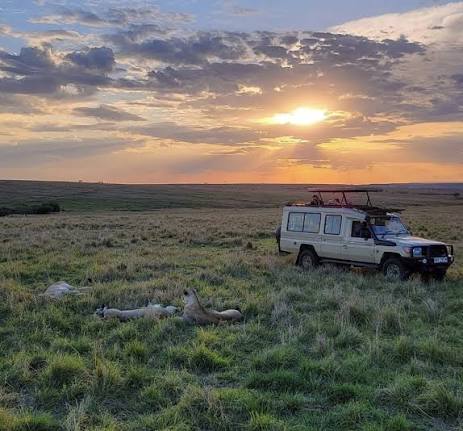
Safari vehicles watching wildebeest cross the Mara River near Entim Camp
What Makes Entim Camp Area: Mara Safari the Migration Route Different
A safari that is close to the animals changes how you spend your day. You do not have to deal with a lot of safari vehicles at a crossing point. You do not have to guess which way to go based on what you hear on the radio. At Entim, the animals often come to you. The camp is small with around a dozen tents. This means you never have to share the view with a crowd.
The tents are on platforms above the river. Each tent has its private deck. The walls of the tents are made of canvas, so you can hear the river at night. You can hear hippos grunting, hyenas calling, and sometimes a lion making its way along the water. The tents are simple and cozy inside. They have floors, quiet colors, comfortable beds, and bathrooms with hot water.
The guides at Entim know the area well. They grew up here. They can tell how a herd of animals is feeling before they move. They know which trees the leopards like to sleep in and where the crocodiles like to hide. When you go on a game drive, it does not feel like you are just checking things off a list. It feels like you are following someone who has spent their life paying attention to this place.
Even when it is not migration season, there are still a lot of animals in the area. Lion groups live near the camp. Elephants come to drink water in the morning. The fields, near the river, have a lot of giraffes, buffalo, and antelopes. If you visit in February or March, you will still see a lot of things to take pictures of, even if the animals are not crossing the river. Entim Camp Area is a place to see the Mara Safari migration route. The Mara Safari migration route is very interesting. Entim Camp Area is special because of the Mara Safari migration route.
Planning Your Visit
If seeing the wildebeest crossing is your goal, timing is everything. The best time to see them is from July to September, when they are closest to the river. August is usually the month with many dramatic crossings. You can’t predict when they will jump, and that’s what makes it so exciting. Sometimes they just stand on the riverbank for two or three days, testing the water before they all jump in together.
When planning your Entim Camp Area: Mara Safari the Migration Route trip, be flexible with your schedule. Staying for three to four nights gives you a chance of seeing a crossing. It also leaves time to explore the rest of the reserve.
The days start early before sunrise when the light is golden, and predators are still active. In the afternoons, you can go on another drive. Watch the sunset with drinks at a nearby viewpoint.
The food at camp is simple and fresh, with bread baked in the morning and local produce. Dinners are often outside facing the river so you can hear the water. See the stars.
If you want a view, you can take a hot air balloon ride at dawn. It shows you just how big the herds are and how the river runs through the grassland.
Meals at camp lean toward fresh, simple cooking, often with bread baked that same morning and produce sourced locally where possible. Dinners are frequently served under open sides facing the river, so you eat with the sound of the water nearby and the stars doing most of the lighting.
If you want an added perspective, several camps in the area, including Entim, offer hot air balloon flights at dawn. Floating above the plains as the sun comes up gives you a different sense of scale entirely, showing just how far the herds stretch across the grassland and how the river cuts through it all like a single dark seam.
A Front Row Seat Worth Choosing
People who have watched the migration from afar say it’s a mix of amazing and disconnected. At Entim Camp, you’re close to the action. You hear the sound of hooves on mud. Feel the tension in the air. You see, individual animals make decisions that affect thousands of others.
This kind of access changes how you talk about your safari. It’s not just about ticking a box; it’s a memory of watching nature happen. Guests often talk about the waiting as much as the crossing itself. The long quiet moments before the jump build anticipation that you just can’t get from TV.
For anyone thinking about where to stay in Kenya during migration season, Entim Camp Area: Mara Safari, the Migration Route is a choice. The camp doesn’t try to compete with the spectacle; it just lets you watch. Few places in East Africa let you see the Great Migration up close like this.
If you want to experience the wildebeest migration in a way, this stretch of the Mara River is worth considering. Book ahead of time for peak months since the camps fill up quickly. What you get is a safari built around one of the amazing natural events on the planet, seen from a place that’s right at its edge.


